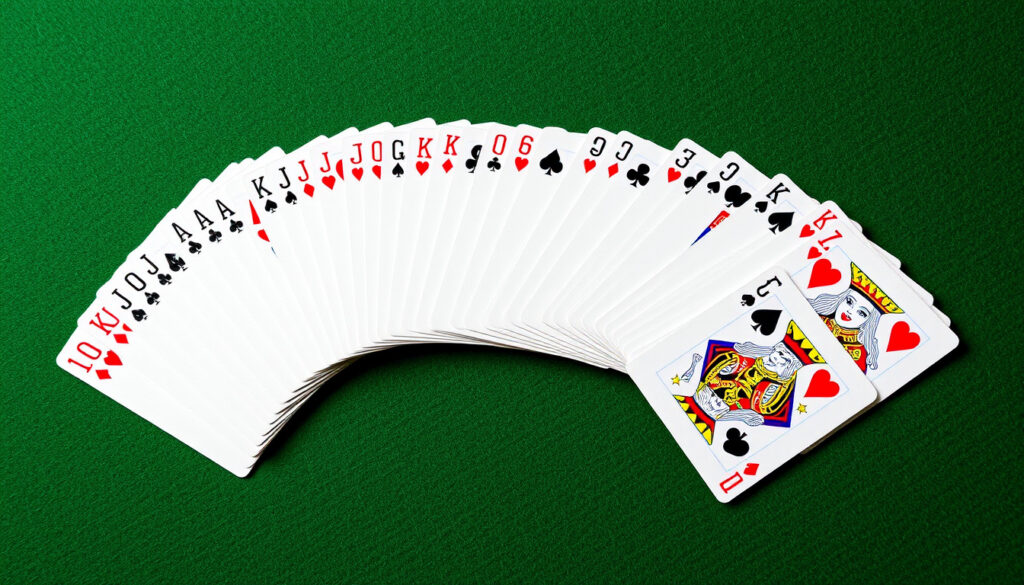
How Many Cards in a Deck – 52 or 54? Suits, Ranks, History
How Many Cards Are in a Deck of Playing Cards?
A standard deck of playing cards contains 52 cards, though many decks include two jokers for a total of 54. These cards are divided into four suits with thirteen ranks each, forming the foundation for hundreds of games played worldwide. The familiar red and black color scheme, with hearts and diamonds in red and clubs and spades in black, emerged from French innovations around 1480 that streamlined printing with stencils.
The deck’s structure has remained remarkably consistent since standardization in fifteenth-century France, though the path from ancient Chinese origins to modern tables involved centuries of evolution across multiple civilizations. Today, this 52-card format dominates card games from poker to bridge, though regional variations and game-specific decks continue to exist alongside the Western standard.
Understanding deck composition matters whether you’re learning a new card game, performing magic tricks, or simply satisfying curiosity about everyday objects. The math behind the deck—the equal red-black split, the thirteen ranks per suit, and the four-card hierarchy—creates the complexity that makes countless game strategies possible.
How Many Cards Are in a Standard Deck of Cards?
Key Insights
- The 52-card count mirrors the number of weeks in a year, though historians debate whether this connection was intentional or coincidental
- Equal distribution of red and black cards (26 each) facilitates quick sorting and game mechanics
- Jokers first appeared in the 1850s as part of the American Euchre craze, becoming standard additions by the late nineteenth century
- The French standardized the four-suit system around 1480, replacing earlier regional variations across Europe
- Modern design features like corner indices and double-headed court cards emerged in the 1860s and 1880s
- Casino-grade decks often exclude jokers entirely, as they serve no function in most house games
- Some specialty games use stripped decks with fewer cards, but 52 remains the universal standard
Quick Reference Table
| Component | Count | Details |
|---|---|---|
| Standard deck size | 52 | Core cards used in most games |
| With jokers | 54 | Two jokers typically included |
| Number of suits | 4 | Hearts, diamonds, clubs, spades |
| Cards per suit | 13 | Ace through 10 plus three face cards |
| Red cards | 26 | Hearts and diamonds |
| Black cards | 26 | Clubs and spades |
| Face cards per suit | 3 | Jack, queen, king |
| Number cards | 36 | Ace (counted) through 10, four per suit |
Does a Deck of Cards Include Jokers?
Jokers are not part of the official 52-card standard deck. Most commercially sold card sets include two jokers, bringing the total to 54, but these extras remain optional depending on the game being played. The Joker’s origins trace to mid-nineteenth-century America, specifically as a result of the popularity of the game Euchre, where a powerful trump card called the “best bower” inspired the creation of an even higher trump that eventually evolved into the modern joker.
Jokers function as wild cards in many games, allowing players to designate them as any card they need. However, professional poker tournaments, bridge clubs, and most casino games explicitly exclude jokers from play.
52 Cards vs. 54 Cards: What’s the Difference?
The distinction between a 52-card and 54-card deck hinges entirely on jokers. When someone asks how many cards in a deck, the technically correct answer for standard Western playing cards is 52. These 52 cards form the complete system of suits and ranks used for poker, bridge, blackjack, and virtually every other mainstream card game.
Jokers add two additional cards that break the suit-rank system. They possess no suit of their own and typically feature jester imagery rather than traditional face designs. Some games incorporate them as wild cards, while others use them for scoring variations or simply discard them before play begins.
Why Do Jokers Come in Pairs?
Two jokers became standard because early American manufacturers wanted consistency with the paired court cards (kings and queens) and to provide backup cards for scoring games. The tradition stuck even as the practical need for duplicate wild cards diminished in most gaming contexts.
How Many Suits and Ranks Are in a Deck?
A standard deck contains exactly four suits: hearts, diamonds, clubs, and spades. The French innovation of standardizing on four suits rather than the earlier regional variations (such as German decks with leaves, acorns, and bells) created the template that eventually spread worldwide. Two suits appear in red (hearts and diamonds) while two appear in black (clubs and spades), a division that serves both aesthetic and practical purposes in gameplay.
Understanding the Four Suits
Each of the four suits contains thirteen cards spanning the numerical and face ranks. The heart suit, with its familiar red heart symbol, represents emotions and appears throughout art and literature as a symbol of matters of the heart. Diamonds, also displayed in red, trace their geometric shape to the playing card symbols used by French printers. Black suits include clubs, depicted as a three-leaf clover design, and spades, shaped like a pointed spear or leaf that evolved from medieval sword imagery.
The Thirteen Ranks Per Suit
Each suit contains thirteen distinct ranks that form the backbone of card game hierarchy. The ace occupies a flexible position—it can function as the highest card in some games (particularly in straights like A-K-Q-J-10) or as a one in others (such as in card counting for blackjack). Cards two through ten carry their numerical value, while the jack, queen, and king round out the suit as face cards featuring historical or allegorical figures.
The three face cards per suit evolved from medieval European traditions. Early decks featured a king, queen, and knave (later cavalier), with queens only added to some European decks around the late fifteenth century after initially being excluded from German and Italian variations.
Why Does a Standard Deck Have 52 Cards?
The mathematical formula behind 52 is elegant: four suits multiplied by thirteen ranks equals fifty-two cards. This number proved ideal for printing efficiency, fitting neatly onto standard sheet sizes without waste, which helped standardize the format across manufacturers. Some historians have noted that 52 also corresponds to the 52 weeks in a year, while the thirteen cards per suit allegedly mirror lunar cycles, though these connections remain debated among scholars rather than serving as definitive explanations.
Deck Variations for Different Games Like Poker
Poker relies on the full 52-card deck (sometimes with jokers as wild cards in home games) to create the familiar hand rankings from high card through royal flush. The number of possible five-card combinations from a 52-card deck—2,598,960 distinct hands—provides the mathematical foundation for poker strategy and odds calculations. Professional tournaments use casino-grade decks without jokers, exchanging them regularly to prevent wear that might reveal card edges.
Bridge Deck Requirements
Bridge utilizes the complete 52-card deck, dealing all cards to four players with thirteen each. Partners sit opposite each other, and the bidding process involves communicating information about hand strength through a standardized system. Bridge assigns suit hierarchy (spades highest, then hearts, diamonds, and clubs) for trump determination and trick-taking calculations.
Regional and Game-Specific Variations
Several notable variations exist alongside the standard 52-card deck. Pinochle uses 48 cards with two copies of certain ranks. Skat, popular in Germany, employs a 32-card stripped deck. Tarot decks contain 78 cards including the traditional trump arcana that developed separately from standard playing cards. Some Asian playing card traditions maintained completely different suit systems, such as Chinese money-suited decks or Japanese hanafuda cards that use seasonal flower motifs instead of western suit symbols.
The shift from 48-card decks (popular in Germany and Italy before standardization) to 52 cards occurred gradually as French playing card patterns dominated international trade. The 52-card format eventually won out due to manufacturing efficiency and the global spread of French-influenced card games.
The History and Evolution of the 52-Card Deck
Playing cards originated in ninth-century China during the Tang Dynasty, where paper money-suited decks featured cards divided into four suits representing different denominations of currency. These early Chinese cards spread along trade routes to Persia and then to Mamluk Egypt, where the Islamic prohibition against depicting human figures led to abstract suit symbols—cups, coins, swords, and polo sticks—and numerical ranks from one to ten. By the 1370s, playing cards had arrived in Europe through Spain and Italy, beginning their transformation into the modern deck.
- 14th Century: Playing cards arrive in Europe from Islamic territories via Spain and Italy; early European cards feature 52 cards with Mamluk-influenced suits
- Early 15th Century: German and Italian regional decks emerge with adapted suit symbols; some regions initially exclude queens, using only kings and knaves
- Around 1480: French manufacturers in Rouen standardize the 52-card deck with familiar French suits (spades, clubs, diamonds, hearts); introduce red/black color division for easier printing
- 16th Century: English pattern develops from French imports; local production begins in London with simplified court card designs
- 19th Century: Jokers introduced around 1850 for American Euchre games; double-ended court cards appear around 1860; corner indices added by 1880
- Modern Era: Bicycle Cards and other manufacturers establish the contemporary standard with plastic coatings and casino-grade materials
What We Know for Certain About Deck Composition
Established Facts
- The standard Western deck contains exactly 52 cards
- Four suits exist: hearts, diamonds, clubs, spades
- Two suits are red, two are black
- Each suit has thirteen ranks
- Card games documented in Europe date to the 1370s
- French standardization occurred around 1480
Uncertain or Debated Points
- Whether 52 weeks connection was intentional
- If suits represent medieval class divisions
- Precise role of Chinese cards in European development
- Original court card figures’ identities
- When jokers first appeared in American decks
- Meaning behind early Mamluk suit symbols
The Significance of Playing Cards in Gaming Culture
The 52-card deck represents one of humanity’s most successful standardized tools, enabling entertainment, gambling, education, and even magic performances across cultures and centuries. The balance between simplicity—four suits, thirteen ranks—and combinatorial complexity creates endless strategic possibilities. A deck weighing mere ounces can generate trillions of possible shuffles, ensuring no two games unfold identically.
Modern playing cards serve functions beyond gaming: tarot readings draw from card symbolism, motivational tools use card-based frameworks for self-reflection, and close-up magicians rely on deck manipulation as a core skill. The standard deck’s ubiquity means most people encounter it daily without recognizing the centuries of cultural exchange and mathematical elegance embedded within those fifty-two cards.
Expert Sources on Standard Playing Cards
“The standard 52-card deck consists of four suits—clubs, diamonds, hearts, and spades—with 13 ranks per suit. The four suits may have been derived from the French version of the German suits: trèfles (clovers, i.e., clubs), carreaux (tiles, i.e., diamonds), cœurs (hearts), and piques (pikes, i.e., spades).”
“Playing cards were invented in China, probably during the ninth century. The first mention of cards in Europe is found in a 1379 register from Spain.”
“Jokers were introduced around the 1850s as a result of the popularity of the American game Euchre. In Euchre, the highest trump card is the Jack of the trump suit, called the ‘right bower,’ and there was a second Jack called the ‘left bower’ that acted as a second trump.”
Summary: Key Facts About Deck Size
A standard deck of playing cards contains 52 cards, with most commercial decks adding two jokers for a total of 54. These 52 cards divide evenly into four suits—two red (hearts and diamonds) and two black (clubs and spades)—with thirteen ranks per suit ranging from ace through king. The deck’s composition traces roots to Tang Dynasty China, evolved through Mamluk Egypt and medieval Europe, and was standardized in fifteenth-century France. Today it serves as the foundation for poker, bridge, and countless other games worldwide. For those interested in related topics, exploring energy costs or health optimization offers parallel discussions about everyday objects with deeper complexity than surface appearances suggest.
Frequently Asked Questions
Why does a standard deck have 52 cards?
Four suits multiplied by thirteen ranks equals 52 cards. This number proved ideal for manufacturing efficiency and has remained standard since French standardization around 1480.
What are the ranks in a standard deck?
Each suit contains ace, two through ten, jack, queen, and king. Ace may function as high or low depending on the game rules.
How many cards in a poker deck?
A standard poker deck contains 52 cards (sometimes 54 with jokers used as wild cards in home games). Professional tournaments use only the 52 core cards.
How many suits are in a deck of cards?
Four suits: hearts, diamonds, clubs, and spades. Hearts and diamonds appear in red; clubs and spades appear in black.
How many red cards are in a deck?
There are 26 red cards—13 hearts and 13 diamonds. This equals the number of black cards, creating perfect balance.
Are jokers included in the 52-card count?
No. Jokers are extras that bring the total to 54 when included. Many games do not use jokers at all.
What games use fewer than 52 cards?
Some regional games use stripped decks. Skat uses 32 cards, pinochle uses 48, and tarot contains 78 cards with additional trump suits.
When were playing cards invented?
Playing cards originated in ninth-century China. They reached Europe by the 1370s and were standardized to the modern 52-card format by around 1480 in France.
More related posts
 The Apothecary Diaries Season 2 – Where to Watch and Episode Guide
 Proverbs 3:5-6 – Meaning, Context and Application
 Restaurants Open Near Me – How to Find Them Right Now
 How the Grinch Stole Christmas 1966: Watch, Stream & Facts
 Apple Pay Customer Service: Phone, Chat, Email & Refund Help
 Current Time in California Now: PST, PDT & Time Zone Guide
 Nottm Forest vs Man City: TV channel, head-to-head & prediction
 How to Take a Screenshot on a Chromebook – Shortcuts and Fixes