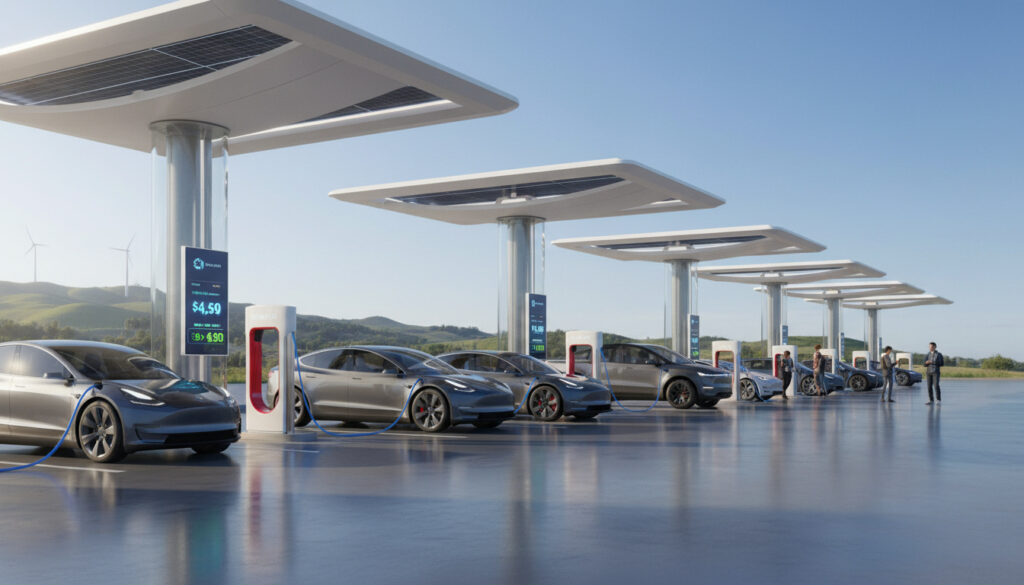
How Much Does It Cost to Charge a Tesla – 2026 Costs by Model
Charging a Tesla costs significantly less than fueling a gasoline vehicle, with home electricity rates averaging $0.15 to $0.17 per kilowatt-hour across the United States. A complete charge typically ranges from $11 to $18 for most models when using residential power, delivering substantial savings over traditional fuel costs.
Understanding the precise economics requires examining multiple variables. Battery capacity varies by model, from the compact Model 3 to the robust Cybertruck, while charging location—home versus public Supercharger—creates price differentials ranging from 4 cents to nearly 60 cents per kilowatt-hour. Analysis by Solar Reviews confirms these variations depend heavily on local utility rates and specific vehicle configurations.
This examination breaks down current 2026 pricing data, examining residential charging expenses, public infrastructure costs, and per-mile efficiency comparisons against internal combustion vehicles.
How Much Does It Cost to Charge a Tesla at Home?
$11–$18
$0.30–$0.60+/kWh
4–6¢ vs. 13–16¢
Rates, Model, Location, Efficiency
- Home charging costs approximately 70% less than public DC fast charging infrastructure.
- U.S. average residential electricity rates currently sit at $0.15–$0.17 per kWh.
- Full home charges typically require $11–$18 depending on specific battery capacity.
- Charging systems operate at 85–90% efficiency, increasing actual energy drawn.
- Time-of-Use rates can reduce expenses by 20–50% when charging overnight.
- Per-mile operational costs average 4–6 cents for home charging scenarios.
- Level 2 home equipment installation ranges from $500–$2,000+.
| Model | Battery (kWh) | Full Charge Cost | Range (miles) | Cost per Mile |
|---|---|---|---|---|
| Model 3 (Standard) | ~69–75 | $10.94–$12.03 | 272–363 | 4.4¢ |
| Model 3 Long Range/Perf. | 82–92 | $12–$16.05 | 303–363 | 4.4–5.3¢ |
| Model Y (Standard/LR) | 75–91 | $10.98–$15.95 | 277–337 | 4.7–5.6¢ |
| Model Y Perf. | 75–90 | $13.20–$15.63 | 277–311 | 4.9–5.6¢ |
| Model S (Standard) | 100–111 | $14.63–$19.37 | 402 | 4.3–4.8¢ |
| Model S Plaid | 100–112 | $14.63–$19.62 | 320 | 6.1¢ |
| Model X (Standard) | 100 | $14.63–$17.55 | N/A | N/A |
| Model X Plaid | 100 | $14.63–$15.35 | N/A | N/A |
| Cybertruck | 123 | $29.22+ (est.) | N/A | N/A |
Data compiled by 8MSolar indicates these costs assume 85–90% charging efficiency and U.S. average electricity rates.
Tesla Supercharger Costs Explained
Public DC fast charging through Tesla’s Supercharger network averages $0.30–$0.45 per kWh across U.S. locations in 2026. High-demand stations in congested corridors or peak travel periods escalate to $0.50–$0.60+ per kWh, representing two to three times the cost of residential charging.
Current Supercharger Rates Across the U.S.
Pricing structures vary by state and specific station location. Recharged.com documentation shows base rates typically fall between $0.30 and $0.45, though dynamic pricing algorithms adjust costs based on real-time demand and local electricity wholesale rates.
Full Charge Costs on the Road
Complete charges at Superchargers range from $18 to $57 or more depending on battery size. A Model 3 standard battery requires approximately $19–$46 for a full charge, while Model S Plaid variants reach $23.75–$57. These costs remain competitive with gasoline on a per-mile basis, typically running 10–18 cents per mile compared to 13–16 cents for conventional vehicles.
Supercharger locations experiencing high demand can implement pricing exceeding $0.60 per kWh during peak travel windows, effectively doubling standard session rates.
Full Charge Costs by Tesla Model
Battery capacity serves as the primary determinant of full-charge expenses. Entry-level vehicles with smaller batteries require less energy storage, while performance and luxury variants with expanded ranges incur higher costs.
Compact and Mid-Size Economics
The Model 3 lineup presents the most economical charging profile, with standard variants utilizing 69–75 kWh batteries resulting in $11–$16 costs. Model Y SUVs, currently Tesla’s volume leader, average $11–$16 for standard configurations, delivering 277–337 miles of range per charge cycle.
Luxury and Performance Vehicle Costs
Model S sedans and Model X SUVs require 100+ kWh capacities, pushing full-charge expenses to $15–$20. The Cybertruck, with its 123 kWh battery pack, represents the highest charging cost in the lineup, potentially exceeding $29 per full charge at home and significantly more via Superchargers. EVAdept calculators provide model-specific estimates based on zip code electricity rates.
Tesla Charging Cost Per Mile vs. Gas Cars
Comparative analysis reveals substantial operational savings. Home charging delivers 4–6 cents per mile, while gasoline vehicles average 13–16 cents per mile assuming $3.50 per gallon and 25–30 MPG efficiency. This represents a 64% cost reduction for Model Y owners charging residentially.
Per-Mile Economics
Supercharging, despite higher rates, maintains competitiveness at 10–13 cents per mile, undercutting gasoline in most scenarios. EnergySage research confirms EVs maintain advantages even when utilizing public infrastructure exclusively.
Annual Operating Budgets
Drivers covering 12,000 miles annually spend approximately $480–$720 on home electricity versus $1,560–$1,920 for gasoline. Even mixed charging scenarios—combining 70% home and 30% Supercharger usage—typically yield $600–$900 annual costs, maintaining 40–50% savings over combustion vehicles.
Time-of-use plans often reduce overnight rates to 8–12 cents per kWh, cutting full-charge costs by 50% or more compared to peak afternoon periods.
Due to 85–90% efficiency rates, a 75 kWh battery requires approximately 88 kWh from the grid to reach full capacity, adding 10–15% to raw electricity calculations.
Factors Affecting Tesla Charging Costs
Multiple variables influence final expenses beyond base electricity rates. Geographic location, utility plan structures, and equipment choices create significant cost differentials.
Regional Electricity Variations
Residential rates span from $0.12 per kWh in some states to $0.30+ in high-cost regions like California and Hawaii. New York averages approximately $0.18 per kWh, translating to roughly $7.30 for a 50 kWh partial charge.
Time-of-Use Rate Structures
Utility providers implement time-of-use plans charging 30–50 cents per kWh during evening peaks but only 8–12 cents overnight. Strategic charging scheduling reduces costs significantly. To understand these costs better, you can explore Tesco Express locations in Ireland. Tesco Express locations in Ireland
Installation and Equipment Requirements
Home Level 2 charger installation, including Tesla Wall Connector hardware and electrical labor, ranges $500–$2,000+. Panel upgrades may increase expenses. Tesla’s charging calculator helps estimate these upfront investments against long-term savings.
How Has Tesla Charging Pricing Evolved?
- : Tesla introduces complimentary Supercharging for early Model S adopters to establish infrastructure loyalty.
- : Company transitions to pay-per-use Supercharger pricing to fund network expansion and reduce congestion.
- : Membership tier system launches, offering discounted rates for monthly subscription holders.
- : Dynamic pricing algorithms implemented, adjusting real-time costs based on station demand and local electricity rates.
What Charging Cost Information Is Definitive?
Established Costs
- Home charging averages $0.15–$0.17 per kWh nationally
- Supercharger base rates range $0.30–$0.45 per kWh
- Per-mile costs: 4–6¢ home, 10–18¢ Supercharger
- Charging efficiency loss: 10–15%
Variable Factors
- Exact rates at specific local stations vary by demand
- Future membership pricing structures remain unannounced
- Individual battery degradation effects on long-term costs
- Seasonal electricity rate fluctuations by utility
For precise current rates at any location, the Tesla mobile application provides real-time pricing visibility before charging sessions begin.
What Context Shapes Tesla Charging Economics?
Residential electricity markets vary dramatically by state, with some regions offering rates near $0.12 per kWh while others exceed $0.30. These geographic disparities create significant differences in annual charging expenses for identical vehicles. Federal incentives currently offer tax credits covering up to 30% of home charging equipment installation costs, potentially offsetting the $500–$2,000 setup expense required for Level 2 hardware.
Understanding technology costs extends beyond automotive contexts. For reference on optimizing other device functionalities, see How to Take a Screenshot on a Chromebook – Shortcuts and Fixes.
Sources and Industry Perspectives
“Supercharging rates vary by location and time.”
— Tesla Official Documentation
“Electric vehicle charging averages approximately 3 cents per mile when utilizing optimal home charging infrastructure.”
— Environmental Protection Agency Analysis
Data aggregation provided by energy.gov and independent solar research organizations.
Key Takeaways on Tesla Charging Expenses
Home charging remains the most economical option, with full charges costing $11–$18 compared to $18–$57+ at Superchargers. The 4–6 cent per-mile operational cost undercuts gasoline vehicles by approximately 60–70%. While home installation requires upfront investment between $500–$2,000, long-term savings accumulate rapidly for regular drivers. For additional technical exploration, consider High Speed Object A11pl3Z NASA – Interstellar Comet Facts.
Frequently Asked Questions
How long does it take to charge a Tesla and how much does it cost?
Level 2 home charging requires 8–12 hours for a full charge, costing $11–$18. Superchargers add 15–45 minutes for 80% capacity, priced at $19–$46 depending on the model and local rates.
How much does it cost to install a Tesla home charger?
Installation of a Level 2 wall connector typically ranges from $500 to $2,000, including hardware and electrical labor. Panel upgrades may increase costs. Federal tax credits can offset up to 30% of this expense.
Is Tesla home charging free?
No, home charging requires payment for electricity consumed, billed by your utility provider at residential rates averaging $0.15–$0.17 per kWh. The charging equipment itself is a one-time purchase.
How much electricity does a Tesla use per charge?
Usable battery capacities range from 69 kWh to 123 kWh depending on model. Accounting for 85–90% charging efficiency, the actual grid draw ranges from approximately 80 kWh to 145 kWh per full charge.
Does Tesla charge by the kWh or by the minute?
Tesla primarily bills by kilowatt-hour consumed in most jurisdictions, though some regions with regulations require time-based billing. Idle fees apply per minute when occupying a stall after charging completes.
Is it cheaper to charge a Tesla overnight?
Yes, time-of-use plans often reduce overnight rates to 8–12 cents per kWh, cutting full-charge costs by 20–50% compared to peak afternoon rates.
More related posts
 Hello Kitty and Spider-Man: Fan Ships, Merch & Art Guide
 USD to Philippine Peso: Current Rate & Practical Guide
 Drive u 7 Home Guide: Unblocked Browser Games Free
 New Chick-fil-A Sandwich – Jalapeño Ranch Club Details
 63 Inches in Feet: Exact Conversion and Height Context
 Do Blue Light Blocking Glasses Work? Evidence Review
 Utah Jazz vs Brooklyn Nets Match Player Stats & Head-to-Head
 How Many Cards in a Deck – 52 or 54? Suits, Ranks, History