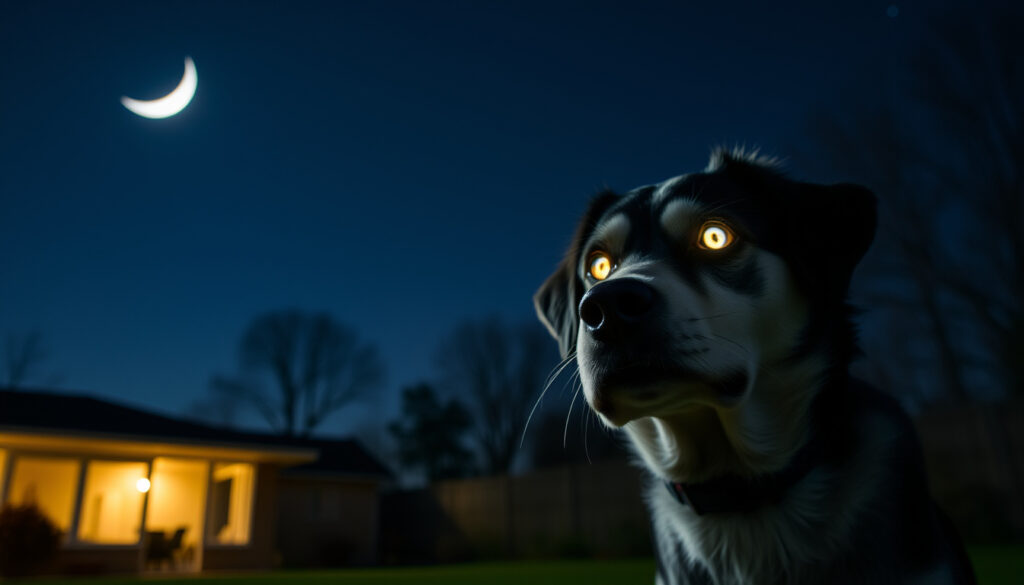
Can Dogs See in the Dark? Night Vision Facts
Dogs need only about one-sixth of the light humans require to see, thanks to a reflective layer behind their retina called the tapetum lucidum that improves low-light vision. This guide examines the anatomy behind canine night vision, how it compares to cats and humans, and what your dog actually sees when the lights go out.
Minimum light needed for dog vision: 1/6 of human requirement ·
Rod cells in dog retina: Significantly more than humans ·
Tapetum lucidum presence: Present in dogs, absent in humans
Quick snapshot
- Dogs have a tapetum lucidum that improves low-light vision (PetMD (veterinary health authority))
- The exact visual experience of dogs at night remains unknown (Wisdom Panel (genetic testing authority))
- Research on canine color perception at night is ongoing (ASPCA Pet Insurance (pet wellness authority))
- The impact of aging on night vision is still being investigated (Embrace Pet Insurance (pet insurance provider))
Here are the key anatomical features that give dogs their night vision edge.
| Feature | Value |
|---|---|
| Tapetum Lucidum | Present in dogs, reflects light |
| Rod Cells | More than humans, fewer than cats |
| Minimum Light Needed | 1/6 of human requirement |
| Field of View | 240 degrees |
| Color Vision at Night | Blue and yellow shades |
Can dogs see at night without light?
The role of the tapetum lucidum
The tapetum lucidum is a reflective layer behind the retina that acts like a mirror, bouncing unabsorbed light back through the photoreceptors. According to PetMD (veterinary health authority), this is why dog eyes glow in flash photos and why they can see in dim light far better than humans. The tapetum gives a second chance for light to hit the rods, effectively boosting sensitivity.
Rod cells vs cone cells
- Dogs have a rod-dominated retina, designed for motion and shape detection in low light (Wisdom Panel (genetic testing authority)).
- Humans have more cone cells, which provide sharp color vision but struggle in dim conditions.
- Both dogs and cats have more rods than cones, while humans have the opposite balance (Wisdom Panel).
Low-light vision threshold
Dogs need only about one-sixth of the light humans require to see. Their larger pupils also let in more light (PetMD). However, none of these adaptations work in absolute darkness — no animal can see without any light at all.
Dogs sacrificed daytime visual acuity for nighttime mobility. For a pet owner, this means your dog can follow a tennis ball at dusk but won’t see a squirrel in total blackout.
“Dogs can see in the dark, but not in the way that you could see if you used night vision goggles.”
— PetMD
What does a dog’s vision look like at night?
Field of view and peripheral vision
- Dogs have a wider field of view — roughly 240 degrees compared to 180 degrees in humans (Embrace Pet Insurance (pet insurance provider)).
- This wide angle helps detect movement, an evolutionary advantage for spotting prey or danger.
Color perception at night
At night, dogs see mostly in shades of blue and yellow. Red and green appear as gray tones because their retinas have only two types of cone cells — dichromatic vision, similar to red-green color blindness in humans (ASPCA Pet Insurance (pet wellness authority)).
Motion detection
Their rod-rich eyes are exceptionally tuned to detect motion at greater distances, even in dim light (PetMD). This explains why a dog can spot a rabbit darting across a field at twilight while a human would miss it entirely.
For evening walks, your dog uses motion cues more than color. That flickering leaf is far more interesting than the red car parked nearby.
The implication: your dog relies more on motion cues than color in low light.
Can dogs see in full darkness?
What happens in complete absence of light
No animal sees in absolute darkness because vision requires photons. According to PetMD, dogs still need some ambient light — think starlight or moonlight — to navigate. In a windowless room with zero light, a dog gropes as blindly as a human.
Comparison to human vision in darkness
- In pitch black, both dogs and humans rely on other senses — hearing, smell, spatial memory.
- Dogs have the advantage of a keener sense of smell and hearing to compensate.
- The tapetum lucidum provides no benefit without any light to reflect.
What this means: even the best‑adapted eyes are useless without photons.
What do dogs see at night vs humans?
Differences in retinal structure
One contrast, two winners: dogs own the low-light league; humans dominate sharp daytime detail. Dogs have many more rod cells, humans have many more cones. Wisdom Panel notes that dogs’ eyes are structurally closer to cats’ than to humans’, yet the human retina still shares the same basic plan — just with different priorities.
Night vision acuity
- Dogs can detect movement and shapes in light that is only 1/6 as bright as what humans need.
- Humans have about 20/20 vision in daylight; a dog’s daytime acuity is estimated around 20/75, but at night their advantage reverses (Embrace Pet Insurance).
Trade-offs: night vision vs color vision
The evolutionary bargain is clear: dogs traded fine detail and broad color for motion sensitivity and low-light capability. ASPCA Pet Insurance emphasizes that dogs distinguish shapes and motion better than humans at night, but they see the world in a faded blue-yellow palette.
What your dog gains in peripheral motion detection, they lose in sharpness. A person reading a sign at dusk would see letters; a dog would see a blurry shape.
The catch: the trade‑off between night vision and daytime sharpness is a fundamental biological compromise.
Can dogs see in the dark better than cats?
Similarities in eye structure
Both species have a tapetum lucidum, rod-dominant retinas, and large pupils. Embrace Pet Insurance reports that cats have a more efficient tapetum — possibly reflecting light more intensely.
Cats have even more rod cells
- Cats possess about 6–8 times the number of rod cells as dogs in relative terms (Wisdom Panel).
- This gives cats superior low-light vision — they can see roughly six times better than people in dim conditions, whereas dogs are about three to four times better.
Tapetum lucidum in both species
Both have it, but cats’ version appears more reflective. Embrace Pet Insurance notes that this is one reason cat eyes seem to glow brighter at night.
One pattern across species: every advantage brings a limit. Dogs and cats trade color and sharpness for motion and sensitivity.
Three species, one trade-off: the table below shows how they line up.
| Feature | Dog | Human | Cat |
|---|---|---|---|
| Tapetum lucidum | Yes | No | Yes (more reflective) |
| Rod cell dominance | High | Low (cone-dominant) | Very high |
| Night vision vs human | 3–4× better | 1× (baseline) | 6× better |
| Field of view | 240° | 180° | 200° |
| Color vision at night | Blue-yellow | Limited (rods active) | Blue-yellow (similar) |
Confirmed facts
- Dogs can see in dim light better than humans (PetMD)
- Dogs have a tapetum lucidum (PetMD)
- Cats have better night vision than dogs (Embrace Pet Insurance)
- Both dogs and cats have more rods than cones (Wisdom Panel)
- Dogs see mostly blue and yellow at night (ASPCA Pet Insurance)
What’s unclear
- Exactly how dogs perceive color at night is not fully understood
- How aging affects night vision in dogs remains uncertain
- Whether some dog breeds have differing night vision abilities is not well documented
- Research on canine color perception at night is ongoing (ASPCA Pet Insurance)
- The impact of aging on night vision is still being investigated (Embrace Pet Insurance)
The pattern: cats outperform dogs in low light, but both sacrifice color and detail.
“Their secret weapon is the part of the canine eye called the tapetum lucidum.”
— American Kennel Club
For pet owners, the concrete takeaway is this: your dog’s night vision is a serious biological tool — but it’s not a supernatural power. When considering whether to leave a light on for your older dog, the evidence suggests they manage fine with even faint ambient sources, though aging eyes may need extra consideration. For cat owners, the implication is clear: your cat likely outperforms your dog in the dark, so don’t assume they see the same world.
Dogs’ superior low-light vision is shared by many animals, including cats, as explained in this feline night vision article.
Frequently asked questions
Do dogs need a night light?
Not necessarily. Most dogs navigate low-light environments better than humans. However, for senior dogs with potentially declining vision, a dim nightlight may help prevent accidents.
Why do dogs’ eyes glow at night?
The tapetum lucidum reflects light back through the retina, creating the eerie glow. This is the same structure that boosts their night vision (ASPCA Pet Insurance). Blue-eyed dogs may lack a tapetum and show a reddish glow instead.
Can dogs see in the dark like an owl?
No. Owls have specialized tubular eyes with enormous retinas and far more rod cells than any mammal. Dogs are good, but owls are in a different league (Wisdom Panel).
Does dog age affect night vision?
Yes, it’s possible. Like humans, dogs can develop lens clouding (cataracts) or retinal degeneration with age, reducing low-light performance. Embrace Pet Insurance notes that older dogs may struggle more in dim light.
What colors can dogs see at night?
Dogs have dichromatic vision — they see the world predominantly in shades of blue and yellow. Red and green appear gray or brownish (ASPCA Pet Insurance).
Is it true that dogs are colorblind?
Not exactly. They see some colors (blue, yellow) but not red or green. This is similar to red-green color blindness in humans, not complete colorlessness (PetMD).
Can dogs see in the dark better than humans?
Yes. Dogs need only 1/6 the light humans do, making them far superior in dim conditions. But they can’t see in absolute darkness (PetMD).
If your dog has eye concerns, check our guide on Is Pink Eye Contagious? for related symptoms. For more on brain and perception, see What Is Déjà Vu?.
More related posts
 Easy Portuguese Recipes at Home: Quick Dinners & Desserts
 Cast of May December: Main Actors and Characters (2023)
 Asian Grocery Store Near Me – Top Chains Hours Delivery
 Restaurants Open Near Me – How to Find Them Right Now
 Best Debt Consolidation Loans – Top 2025 Picks and Rates
 The Last of Us Season 3: Everything Confirmed So Far
 Redmi Note 13 5G to Buy: Best Prices Ireland
 Where to Watch The Office (2025) – Peacock, Netflix, Amazon