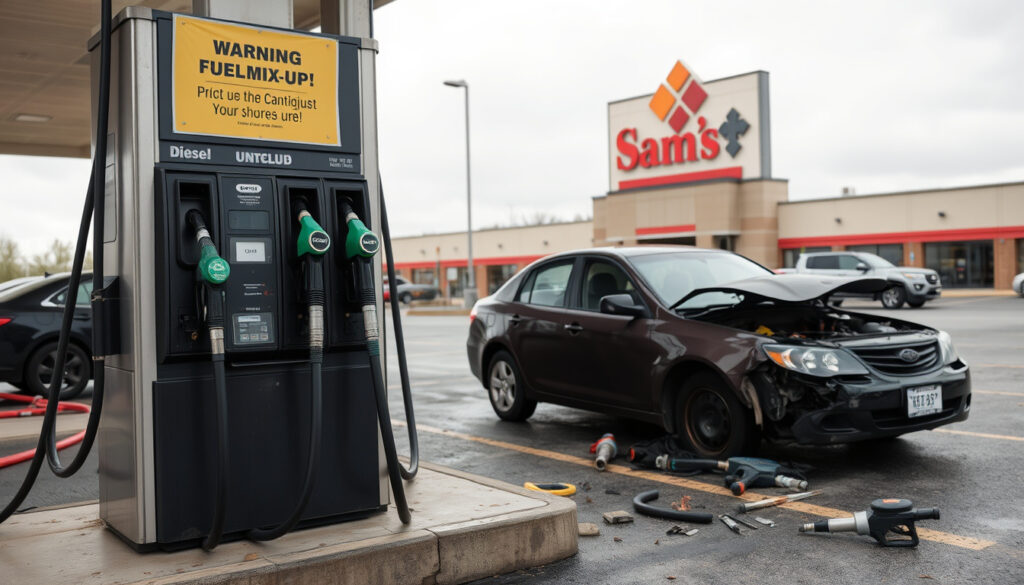
Sam’s Club Ohio Diesel Unleaded Mixup: Repair Costs & Guide
Nobody expects to drive away from a gas station with a $500 repair bill, but that’s what happened in July 2025 at the Sam’s Club fuel station in St. Clairsville, Ohio, where diesel was mistakenly pumped into the store’s unleaded tanks — an error Sam’s Club blamed on a third-party fuel supplier, as The Hill (national politics and business outlet) reported. Here’s what changed for affected drivers, why a $150 charge confused some members, and what to do if contaminated fuel reaches your tank.
Average cost to flush fuel system after mixup: $500 ·
Time required for professional fuel system cleaning: 3 hours ·
Estimated annual fuel mixup incidents in the US: 150,000 ·
Minimum diesel contamination that can damage a gas engine: 1 gallon
Quick snapshot
- Diesel was pumped into the 87-octane unleaded tanks at the St. Clairsville, Ohio, Sam’s Club in July 2025 (Carscoops, automotive news site).
- Sam’s Club blamed a third-party fuel supplier for the mixup (The Hill).
- Cars that took the contaminated fuel typically need the fuel tank drained and the fuel system cleaned (Carscoops).
- How many members pumped contaminated fuel before the affected pumps were shut down; coverage reviewed so far centers on the St. Clairsville location (Yahoo News / WTRF).
- Whether Sam’s Club changed fuel-supplier procedures or pump labeling in Ohio after the incident; no public confirmation has appeared in the reporting reviewed for this article. (Yahoo News / WTRF)
- The specific amount of compensation Sam’s Club will provide to affected members has not been disclosed. (Yahoo News / WTRF)
- July 2025: motorists post complaints online after their cars won’t start (Yahoo News / WTRF).
- Sam’s Club acknowledges the fueling error and points members to its claims process (The Hill).
- Affected members should call the store and submit a claim; the site manager, Cat Litchko, asked customers to do exactly that (Carscoops).
- Before restarting, affected vehicles need professional draining and cleaning to avoid deeper engine damage. (Carscoops)
Eight details, one pattern: a single refueling error turned ordinary pumps into a repair-shop pipeline.
| Detail | What’s known |
|---|---|
| Location | Sam’s Club fuel station, St. Clairsville, Ohio |
| Fuel involved | Diesel and 87-octane regular unleaded |
| Root cause | Third-party fuel supplier error during underground tank refill |
| Date reported | July 2025 |
| First symptom | Vehicles would not start after fueling (Yahoo News / WTRF) |
| Company response | Sam’s Club urged affected members to call the store and submit a claim (The Hill) |
| Fuel supply status | Station ran out of 87 unleaded after the contamination was found (River News) |
| Typical fix | Drain the fuel tank, replace the fuel filter, flush the fuel system |
What happens if you mix regular gas with diesel?
The two fuels look similar enough to fool a distracted driver, but they behave completely differently inside an engine. The damage depends on which direction the mixup happens.
What happens when diesel is added to a gasoline engine?
- A gasoline engine relies on spark plugs to ignite an air-fuel mixture calibrated to a specific octane rating. Diesel is blended for compression ignition, so in a gas engine it burns at the wrong time and temperature.
- The immediate symptoms are rough idling, misfires, white or gray smoke, and in many cases the car won’t start — the symptom St. Clairsville drivers described after fueling at Sam’s Club.
- Mechanically, diesel contamination can clog the fuel filter and reach the fuel injectors, so the standard fix is to drain the tank, replace the filter, and flush the whole system (Carscoops).
What happens when gasoline is added to a diesel engine?
- The reverse mistake is generally the more damaging one. Diesel fuel also lubricates the high-pressure fuel pump and injectors; gasoline has almost none of that lubricating quality.
- Run a diesel engine on gasoline and metal components can wear or fail quickly, sending debris through the fuel rail and turning a fuel-service job into a much larger injection repair.
The implication: either direction is an expensive mistake, but the bill grows fastest when the engine is started and driven. The cheapest moment to catch the error is before the key turns.
Why did Sam’s Club charge me $150 for gas?
Short answer: it was probably a temporary hold, not a final charge. That hold caused real confusion around the St. Clairsville incident, when members were dealing with engine trouble and a surprising pending charge at the same time.
A pending $150 Sam’s Club hold is not a price increase. It’s a pre-authorization that disappears once the pump transaction settles — a detail that made a bad afternoon worse for members who were already watching their cars fail to start.
How Sam’s Club fuel pre-authorization works
- When a member swipes a card at a Sam’s Club fuel pump, the station requests a temporary authorization of $150 before the first gallon flows.
- The hold confirms the card is valid and has funds available. It is not the final purchase amount.
- The actual fuel price is charged when the pump session ends and the transaction settles.
Why the $150 charge appears then disappears
- Pending authorization: the $150 hold shows up immediately in online banking or a mobile app as “pending.”
- Settled amount: within a day or two, the pending hold drops and the real fuel purchase posts. The unused portion of the hold is released back to the cardholder.
- If the card is a debit card, the hold can briefly tie up funds — a common reason members think the station overcharged them.
The takeaway: check the settled transaction before assuming an overcharge. If a $150 hold doesn’t drop off within a few days, that’s a bank-level error, not a fuel-station one.
What happens if I accidentally put a little bit of diesel in my gas car?
“Just a little” is the phrase that gets car owners in trouble. In St. Clairsville, the “little bit” wasn’t the driver’s choice — the pump labeled 87 unleaded was delivering diesel (Carscoops).
Can a small amount of diesel damage a gasoline engine?
- Yes. A gasoline engine isn’t calibrated for diesel’s combustion characteristics, and even a small amount can cause misfires, rough running, and a check-engine light.
- In practical terms, as little as 1 gallon of diesel in a gasoline tank is enough to create drivability problems and trigger warning lights. There is no “top off and hope” scenario here.
What is the safe threshold?
- There isn’t one that a responsible mechanic would endorse. Diesel in a gas engine disrupts combustion, and the longer the mixed fuel runs, the more components get exposed to the wrong chemistry.
- If you catch the mistake at the pump, don’t start the car. Call for a tow and have the tank drained — the cost of a tow and a drain is a fraction of a fuel-system repair.
The catch: a few gallons of diesel in a gas car won’t necessarily destroy the engine, but it will turn a normal commute into an expensive appointment. The safest threshold is zero.
How to flush gasoline out of a diesel engine?
The same fix applies whether the wrong fuel is diesel in a gas tank (the St. Clairsville scenario) or gasoline in a diesel tank: act fast, don’t start the engine, and let a professional drain and flush the system.
The single most expensive move after a wrong-fuel fill is turning the key. A car driven on contaminated fuel can go from a $500 drain-and-flush to a fuel-pump-and-injector replacement within a few miles.
- Step 1: Do not start the engine
- If you catch the mistake before starting, leave the key alone. Every minute of run time pumps contaminated fuel through the filter, injectors, and — for diesel engines — the high-pressure pump.
- If the car won’t start after a fill-up, don’t keep cranking it. Repeated attempts push contaminated fuel deeper into the system.
- Step 2: Tow it to a mechanic
- Don’t drive the car to the shop; the drive itself can finish the damage. A flatbed tow is the safer option, and roadside assistance usually covers it.
- If the mixup happens at a store-owned station, document everything — pump number, receipt, fuel grade — before you leave the lot.
- Step 3: Drain the fuel tank
- The shop will drain the tank completely and dispose of the contaminated fuel properly.
- Depending on the vehicle, the technician may drop the tank or empty it through the filler neck; either way, the goal is zero contaminated fuel left behind.
- Step 4: Replace the fuel filter and flush the system
- Diesel contamination clogs fuel filters and can reach injectors, so the filter gets replaced as part of the service (Carscoops).
- The technician flushes the fuel lines and, for gasoline engines, checks the oxygen sensors and catalytic converter — the components most at risk from the wrong fuel.
- The final step is a clean refill with the correct fuel and a test drive to confirm the car runs smoothly.
The pattern: every step of the fix is about stopping contaminated fuel before it reaches something expensive. The mechanic’s bill is basically a measure of how far the wrong fuel got.
How much does it cost to flush gasoline out of a diesel engine?
Costs swing wildly based on the vehicle, the shop, and how far the engine ran before the mistake was caught. The range below is for a straightforward drain-and-flush, not a component replacement.
Factors affecting cost
- Labor rates: dealerships charge more than independent mechanics for the same service.
- Fuel tank access: some vehicles require dropping the tank or removing rear components, which adds labor time.
- Secondary damage: if the engine was started and driven, costs jump to include new filters, injector cleaning, fuel pump inspection, and possible catalytic converter work.
Average prices for draining and flushing
- A professional fuel-system drain and flush typically runs $300 to $600, with simple jobs around $200 and complex cases up to $800.
- That aligns with coverage of the St. Clairsville incident, where local reporting noted some motorists faced costly vehicle repairs after unknowingly filling with diesel (River News).
- The average commonly cited for a fuel-system flush after a mixup is about $500, and the full job usually takes 2 to 4 hours of shop time.
The cheapest insurance in a wrong-fuel event is documentation: pump number, receipt, and a photo of the fuel grade. That’s the paper trail that turns a Sam’s Club claim from a dispute into a formality.
Insurance coverage possibilities
- Some comprehensive auto insurance policies cover accidental fuel contamination, though the deductible may absorb part of the benefit.
- Because the St. Clairsville error started at the station, affected members also have a claims path with Sam’s Club, which asked them to contact the club directly.
The trade-off: a $300 to $600 flush is cheap insurance against a much larger fuel-system repair. The variable that decides the bill is whether the engine ran on the wrong fuel.
Timeline: How the St. Clairsville mixup unfolded
Five moments explain the entire incident — and the repair pattern that followed.
- July 2025: A fuel delivery refills underground tanks at the St. Clairsville Sam’s Club, and diesel ends up in the 87-octane unleaded tank during the transfer (Carscoops).
- Same day: Members pump what they believe is regular unleaded. Some vehicles would not start after the fill-up.
- Soon after: Complaints spread on social media before broader news coverage, and local reporting notes the station is out of 87 unleaded (Yahoo News / WTRF; River News).
- After complaints surfaced: Sam’s Club confirms a third-party supplier error and directs affected members to its claims process (The Hill).
- Repair phase: Affected cars go to shops for tank drainage, fuel filter replacement, and fuel-system cleaning — a job that typically takes 2 to 4 hours of shop time.
Why this matters: the timeline shows how quickly a silent supplier error became a public, and expensive, consumer problem. The gap between “vehicle won’t start” and “Sam’s Club confirms the mistake” is exactly when most of the repair costs were set in motion.
Confirmed facts vs. what’s still unclear
Confirmed facts
- Diesel was pumped into unleaded tanks at the St. Clairsville, Ohio, Sam’s Club (Carscoops).
- Sam’s Club blamed a third-party fuel supplier for the error (The Hill).
- Affected vehicles need the fuel tank drained and the system cleaned before they’re safe to drive (Carscoops).
What’s unclear
- Exact number of affected members: not disclosed in the reporting reviewed for this article.
- Whether Sam’s Club changed fuel-supplier procedures or pump labeling in Ohio after the incident: unconfirmed in public coverage.
- What share of out-of-pocket repair costs Sam’s Club will cover: the company said it would make things right, but no formula or cap has been published.
The pattern: the confirmed facts are all operational details — what went into the tank, who was responsible, what the fix requires. The unknowns are the accountability questions: how many people, what compensation, and what the company changed afterward.
Voices from the mixup
Sam’s Club corporate communications director Steven Zapata said the company was working to address the issue and make things right for affected members.
Reported by The Hill (national politics and business outlet)
Sam’s Club manager Cat Litchko asked customers who had fuel trouble to call the store directly and submit a claim.
Reported by Carscoops (automotive news site)
Some motorists faced costly vehicle repairs after unknowingly filling with diesel instead of regular unleaded.
Local reporting by River News (Ohio Valley local outlet)
The throughline: Sam’s Club’s public position was responsive, but the repair bills landed on individual members first. How much of that gets reimbursed is still the open question.
What this means
Fuel mixups at retail stations are rare enough to surprise everyone involved and common enough that every auto shop has a story. The St. Clairsville incident was a reminder that a few gallons of the wrong fuel can turn a routine errand into a shop appointment — and that the difference between a $500 fix and a much larger one is usually measured in minutes. For Sam’s Club members in Ohio, the move is clear: document the pump, don’t start the car, have the tank drained and flushed, and file a claim with the club — or accept the risk that today’s misfire becomes tomorrow’s fuel-system replacement.
samsclub.com, samsclub.com, samsclub.com, samsclub.com, samsclub.com, samsclub.com, samsclub.com, samsclub.com
Frequently asked questions
Can I put 1 gallon of diesel in a gas engine?
No. Even 1 gallon of diesel in a gasoline engine can cause misfires, rough running, and a check-engine light, because diesel’s combustion characteristics are wrong for a spark-ignition engine. If you realize the mistake before starting, don’t start the car — have the tank drained.
How long can diesel sit in a tank before it goes bad?
Diesel degrades more slowly than gasoline, but water absorption and microbial growth eventually make it unusable. In the St. Clairsville context, the urgent question wasn’t the diesel’s age — it was the damage it could do to engines designed for unleaded gasoline.
What’s the worst thing for a diesel engine?
Gasoline in the tank. Gasoline lacks the lubricating quality that diesel fuel pumps and injectors need, and coverage of the St. Clairsville incident noted the reverse mixup — gasoline in a diesel engine — is generally more damaging than diesel in a gasoline engine (Carscoops).
How often should a fuel filter be changed on a diesel engine?
Follow the manufacturer’s interval — for many modern diesels that’s roughly every 15,000 to 30,000 miles, but check the owner’s manual. After any fuel contamination event, the filter should be replaced immediately as part of the flush, regardless of mileage.
Is diesel at an all-time high?
Not as of this writing. National diesel averages have been volatile in recent years, but price is driven by crude oil, refining capacity, and taxes. For St. Clairsville drivers in July 2025, the bigger issue wasn’t the price of diesel — it was that diesel reached the wrong tanks.
What are the three reasons not to buy gas at Sam’s Club?
Common complaints about warehouse fuel stations include long lines at busy pumps, a limited number of octane grades, and the membership requirement. The St. Clairsville mixup adds a practical reason to be careful: verify the pump grade before you fill, especially soon after a station has had a fuel delivery.
More related posts
 Free Reverse Phone Lookup: Identify Callers Without Paying
 T-Mobile Pay Bill – Complete Guide to All Methods
 Over-the-Counter Antibiotics – What’s Available and What’s Not
 No Weapon Formed Against Me Shall Prosper: Meaning & Verse
 Pixel 10 Pro Fold: Specs, Price, Release Date & Review
 Why Is My Period Late? Causes, Normal Delay, and When to Worry
 Carl’s Jr. Near Me: Current Locations and Menu (2024)
 Does Zyrtec Make You Drowsy? Side Effects, Duration, Tips