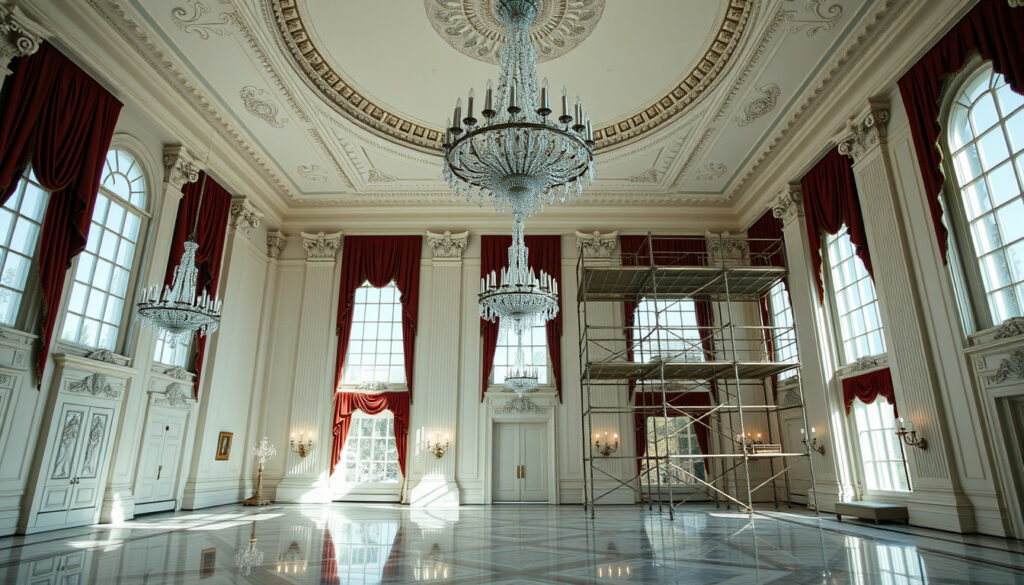
White House East Wing: History, Demolition & New Ballroom
Seeing a bulldozer where the First Lady’s office used to be isn’t something you expect at the White House. In October 2025, the East Wing — a fixture of presidential life since 1902 — was torn down on direct orders from President Trump to make way for a massive new State Ballroom.
Year built: 1902 ·
Year demolished: 2025 ·
Planned new East Wing size: 89,000 sq ft ·
Year expanded (second story): 1942 ·
Notable feature underneath: Presidential Emergency Operations Center (PEOC)
Quick snapshot
- Built in 1902 for social events and state functions (Wikipedia).
- Housed First Lady’s offices and staff (Close Up Foundation).
- Contained famous rooms like the East Room and Vermeil Room. (Wikipedia)
- Presidential Emergency Operations Center (PEOC) built in 1942 (White House Historical Association).
- Used as a secure command post during emergencies. (White House Historical Association)
- Dismantled; new below-grade facility planned, cost undisclosed. (White House Historical Association)
- Original construction in 1902.
- Second floor added in 1942.
- Truman renovation reinforced structure; East Wing updated.
President Trump has confirmed the military is building a “massive complex” under the ballroom, calling the above-ground structure just “a shed.” For taxpayers, the question is whether this is a ballroom project or a national security undertaking dressed as a renovation.
Here is a quick reference table of key facts about the East Wing’s history and specifications.
| Attribute | Value |
|---|---|
| Year built | 1902 |
| Year demolished | 2025 |
| Architect | Nathan C. Wyeth (original), Eric Gugler (1942 expansion) |
| Original purpose | Social and ceremonial events, First Lady’s offices |
| Notable sublevel | Presidential Emergency Operations Center |
| Planned replacement | 89,000 sq ft ballroom (two floors) |
| Year expanded (second story) | 1942 |
| Year gutted (Truman renovation) | 1948–1952 |
What was the East Wing of the White House for?
The East Wing was the social and ceremonial nerve center of the White House. Built in 1902 during Theodore Roosevelt’s expansion, it provided dedicated space for state functions that the cramped original mansion couldn’t handle.
Was the East Wing used for the First Lady’s offices?
Yes — the East Wing housed the First Lady’s offices and the Social Office, a team responsible for planning state dinners and official receptions. This arrangement began in earnest in the 1940s and continued until demolition.
What types of social events were held in the East Wing?
The East Wing contained the East Room, the State Dining Room, and the Vermeil Room — spaces that hosted state dinners, receptions, and the 500,000 annual tours of the White House. It also had a small movie theater used for screenings by the First Family and guests.
The East Wing wasn’t just offices — it was where diplomacy happened over dinner. With the largest current rooms fitting only 200 guests, the White House has relied on tents for big events. The new ballroom, designed to seat up to 900, changes what state dinners look like.
How did the East Wing’s role change over time?
The East Wing evolved from a purely social annex into a mixed-use workspace. By the 2000s, it housed the White House Military Office, the Office of Legislative Affairs, and the Map Room, reflecting the growing administrative load on the modern presidency.
The implication: the East Wing was never one thing. It was a ballroom, an office building, a bunker, and a visitor center simultaneously — and that’s why replacing it is so complicated.
What is located under the East Wing of the White House?
Beneath the East Wing lay the Presidential Emergency Operations Center (PEOC), a secure bunker built in 1942 during World War II. It became famous on September 11, 2001, when Vice President Dick Cheney sheltered there during the attacks.
What is the Presidential Emergency Operations Center?
The PEOC is a reinforced command center designed to function independently of the White House above — with its own communications, air supply, and emergency power.
When was the PEOC built?
Construction began in 1942 under President Franklin D. Roosevelt, who added a second story to the East Wing simultaneously.
How is the PEOC used during emergencies?
It served as a secure location for senior staff and the vice president during 9/11 environments and has been activated for other national security threats. During the East Wing demolition, the PEOC was itself dismantled and a new below-grade facility began construction.
The trade-off: losing the historic PEOC for a classified, military-run replacement means the public will never know exactly what’s being built underneath the new ballroom — which is exactly the point.
Which president gutted the White House?
President Harry S. Truman. From 1948 to 1952, the interior of the White House was completely gutted, reinforced with steel beams, and rebuilt from the inside out.
What was the extent of Truman’s renovation?
Every internal wall was removed, the joists replaced, and the structure fitted with a steel frame. The White House was at risk of collapse — engineers found it held up by its own plaster. The East Wing was preserved but structurally updated during this period.
Why was the White House gutted in the 1940s?
The building had severe structural issues: sinking floors, cracking walls, and a beam that held the bathtub in the Treaty Room had snapped. Engineers declared it unsafe for occupancy.
Did the East Wing survive the Truman renovation?
Yes — the East Wing was retained and its structure was reinforced, though its interior was reconfigured. It remained operational throughout the renovation, unlike the main building, which was completely hollowed out.
The pattern: every major White House renovation has been reactive — fixing what’s broken. The East Wing demolition is the first purely forward-looking structural change in 80 years.
What was really in the East Wing of the White House?
Beyond the famous rooms — the East Room, the State Dining Room, the Vermeil Room — the East Wing contained a movie theater, the White House Library, and the Map Room where Presidents Roosevelt and Kennedy followed WWII and the Cuban Missile Crisis.
Did the East Wing contain a movie theater?
Yes — a small, 42-seat theater was added during the 1942 expansion and used by every First Family since the Roosevelts.
Were there private apartments in the East Wing?
Not for the First Family — the private residence is on the second and third floors of the West Wing area. But the East Wing contained staff quarters and office suites for dozens of White House personnel.
What offices were located in the East Wing?
The First Lady’s press office, the Social Office, the White House Military Office, the Office of Legislative Affairs, and the correspondence team.
The catch: for a building that hosted parties, it was also where 90% of the White House’s daily administrative work happened. Recreating that capacity while adding a ballroom is the real design challenge.
President Trump proposed this exact ballroom to the Obama administration in 2010 — as a real estate developer. His vision for the East Wing predates his presidency by 15 years, making this a personal architectural project as much as a state one.
When was the White House East Wing built?
The original East Wing was constructed in 1902, part of Theodore Roosevelt’s expansion of the White House complex.
Who designed the original East Wing?
Architect Nathan C. Wyeth designed the East Wing in the Colonial Revival style.
How was the East Wing expanded in 1942?
Architect Eric Gugler added a second story and redesigned the interior, which is when the PEOC and the movie theater were built.
What is the architectural style of the East Wing?
Colonial Revival, consistent with the main White House. The new ballroom, designed by architect James McCrery II — hired by Trump on July 13, 2025 — is planned to match this aesthetic externally.
Why this matters: the new East Wing will look like the old one from the outside. The revolution is underground and in square footage — 89,000 sq ft of new space, compared to the original wing’s roughly 50,000 sq ft.
Timeline of the White House East Wing
- 1902: East Wing built as part of Theodore Roosevelt’s expansion.
- 1942: Second story added; PEOC constructed underneath.
- 1948–1952: Truman renovation: White House gutted and reinforced; East Wing updated.
- July 31, 2025: White House announces plans for new ballroom and modernized East Wing.
- October 2025: East Wing demolished on Trump’s direct orders.
- February 19, 2026: Commission of Fine Arts approves renovation 6-0.
- 2026 (planned): Construction of new East Wing with ballroom expected to complete.
What’s clear and what’s not
Confirmed facts
- East Wing originally built in 1902.
- Demolished in October 2025.
- PEOC located beneath the East Wing, built 1942.
- Truman renovation gutted the White House interior 1948–1952.
- New East Wing ballroom planned with 89,000 sq ft.
- Architect James McCrery II hired July 2025.
- CFA approved renovation 6-0 on February 19, 2026.
- Toxic metals found in debris dumped at golf course.
What’s unclear
- Exact total cost of demolition and new construction (estimated $400 million but not finalized).
- Whether the new ballroom will include office space for the First Lady.
- Full environmental impact assessment of debris dumping at the golf course.
- Underground military facility cost and specifications (classified).
“The new ballroom won’t interfere with the existing building — it pays total respect to it.”
— President Donald Trump, quoted in Wikipedia coverage of the July 2025 announcement
“The military is building a massive complex under the ballroom. The ballroom is just a shed above it.”
— President Donald Trump, speaking in October 2025, per Wikipedia
“Demolition debris from the East Wing contained toxic metals dumped at a public golf course, raising environmental concerns.”
— BBC News reporting on environmental assessment
“The East Wing housed the First Lady’s offices, a movie theater, and the Presidential Emergency Operations Center.”
— Close Up Foundation historical summary
The demolition of the White House East Wing is the most dramatic change to the presidential residence since Truman’s wartime renovation — and it carries far greater secrecy. The public will see a larger ballroom. What they won’t see is the classified underground facility that made Trump’s real estate instincts and national security priorities one and the same. For preservationists, the lesson is sobering: the White House is no longer a museum. It’s a construction site. And the next president will inherit something the last one never expected to lose.
Related reading: The East Wing of the White House Is Demolished · White House State Ballroom
Frequently asked questions
Was the East Wing part of the original White House?
No. The original White House was completed in 1800 without an East Wing. The East Wing was added in 1902 during Theodore Roosevelt’s expansion.
What rooms were in the East Wing?
The East Wing contained the East Room, the State Dining Room, the Vermeil Room, a movie theater, the White House Library, the Map Room, the First Lady’s offices, the Social Office, and the White House Military Office.
Did the East Wing contain the First Lady’s bedroom?
No. The First Family’s private residence is on the second and third floors of the main White House and the West Wing area. The East Wing was used for offices and ceremonial spaces.
Is the East Wing still standing?
No. The East Wing was demolished in October 2025 on President Trump’s direct orders to make way for the new State Ballroom.
How large was the East Wing?
The original East Wing was approximately 50,000 square feet. The planned replacement ballroom is 89,000 square feet across two floors.
Will the East Wing be rebuilt?
Yes — a new East Wing with a State Ballroom is under construction, designed by architect James McCrery II, with completion expected in 2026.
What is the Presidential Emergency Operations Center used for today?
The original PEOC was dismantled during the East Wing demolition. A new, classified below-grade facility is being constructed under the new ballroom, with the military involved in the project.
Did the East Wing have a role during 9/11?
Yes — the Presidential Emergency Operations Center beneath the East Wing was activated on September 11, 2001, where Vice President Dick Cheney and senior staff sheltered during the attacks.
Related reading
- White House State Ballroom on Wikipedia
- The East Wing of the White House Is Demolished by Close Up Foundation
- East Wing history from the White House Historical Association
- The Truman Renovation from the White House Historical Association
More related posts
 Portland Trail Blazers vs Toronto Raptors Match Player Stats
 Euro to Dollar Conversion 2025: Rate, Forecast & Timing
 Mr. & Mrs. Smith (2024 TV Series): Season 2, Cast, Reviews
 School Spirits Season 3: Release Date, Episodes, Finale & Season 4
 Razer Viper V3 Pro – Specs, Battery & V2 Pro Comparison
 Lilo and Stitch 2: 2005 vs 2028 Sequel Comparison
 The Last of Us Season 3: Everything Confirmed So Far
 Does Zyrtec Make You Drowsy? Side Effects, Duration, Tips