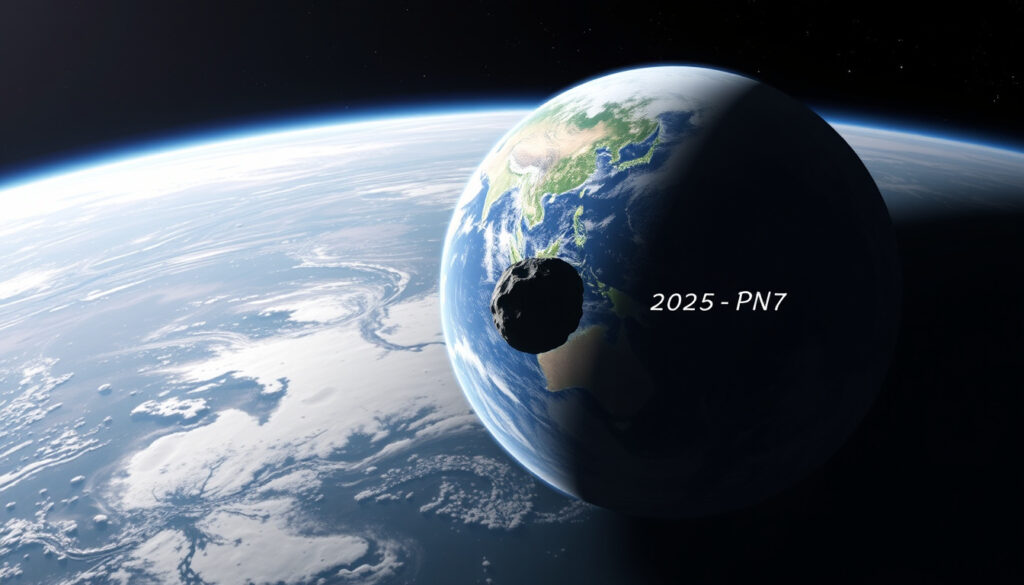
NASA Two Moons Earth Asteroid: Quasi-Moon 2025 PN7
Few space headlines spark as much confusion as the claim that Earth has suddenly gained a second moon. The truth, confirmed by astronomers and NASA data, is more nuanced — and arguably more interesting: Asteroid 2025 PN7, discovered in August 2025, shares Earth’s orbit as a quasi-moon until 2083, and here’s what that actually means and why it’s not what viral headlines suggest.
Asteroid 2025 PN7 orbit duration: Sharing Earth’s orbit until 2083 ·
Quasi-moon Kamo’oalewa discovery year: 2016 ·
Mini-moon 2024 PT5 capture date: September 29, 2024 ·
Estimated diameter of 2025 PN7: About 60 feet (18 meters)
Quick snapshot
- One permanent natural satellite (Wikipedia (astronomical database))
- Gravitationally bound to Earth (Wikipedia (astronomical database))
- Visible every night (Wikipedia (astronomical database))
- Asteroid in 1:1 resonance with Earth (Northeastern Global News (university research reporting))
- Not gravitationally bound (Northeastern Global News (university research reporting))
- Example: Kamo’oalewa (Northeastern Global News (university research reporting))
- Temporarily captured asteroid (Liberty Science Center (science education institution))
- Orbits Earth for months or years (Liberty Science Center (science education institution))
- Example: 2024 PT5 (Liberty Science Center (science education institution))
- Quasi-moon discovered in 2025 (My Modern Met (science and culture outlet))
- Shares orbit until 2083 (My Modern Met (science and culture outlet))
- Size: about 60 feet (My Modern Met (science and culture outlet))
Four key data points help clarify what astronomers actually know about Earth’s orbital companions, from the permanent Moon to temporary visitors.
| Label | Value |
|---|---|
| Earth’s true moon | The Moon (one) |
| Known quasi-moons | 469219 Kamo’oalewa, 2025 PN7, others |
| Recent mini-moon | 2024 PT5 (captured Sept 2024) |
| Asteroid 2025 PN7 orbit end | 2083 |
Is it true that Earth has two moons?
What is a quasi-moon?
- A quasi-moon, or quasi-satellite, is an asteroid that orbits the Sun but appears from Earth to circle our planet.
- It maintains a 1:1 mean-motion resonance with Earth — both objects complete one orbit in roughly the same time (Wikipedia (astronomical database)).
- The key distinction: a quasi-moon is not gravitationally bound to Earth the way the Moon is.
Think of two cars driving side by side on a highway — close enough to seem connected, but each running on its own engine. That’s the relationship between Earth and a quasi-moon, as Liberty Science Center (science education institution) explains.
Difference between a true moon and a quasi-moon
- Earth’s true Moon is a natural satellite that formed from a collision 4.5 billion years ago and is permanently bound by Earth’s gravity.
- A quasi-moon like 2025 PN7 is a near-Earth asteroid that follows a path similar to Earth’s orbit around the Sun (Northeastern Global News (university research reporting)).
- Quasi-moons come and go over decades; true moons are permanent.
The pattern: Every viral “second moon” headline refers to a quasi-moon or a mini-moon, never a true satellite. The implication is that classification matters more than clickbait suggests — Earth still has exactly one permanent moon.
Does Earth really have 2 moons until 2083?
What is asteroid 2025 PN7?
- 2025 PN7 is a small near-Earth asteroid and a confirmed quasi-satellite of Earth, first observed on August 2, 2025 (Wikipedia (astronomical database)).
- The Pan-STARRS 1 telescope at Haleakalā Observatory in Hawaii made the initial detection.
- The Minor Planet Center formally announced 2025 PN7 in a Minor Planet Electronic Circular on August 29, 2025.
- It belongs to the Arjuna asteroid group — near-Earth objects with orbits very similar to Earth’s.
- Astronomers estimate the object measures about 60 to 118 feet wide (My Modern Met (science and culture outlet)).
How long will 2025 PN7 stay in orbit?
- 2025 PN7 is expected to remain near Earth until 2083, after which it will drift away or transition out of the quasi-moon configuration (Northeastern Global News (university research reporting)).
- Older observations suggest the object had likely been a quasi-moon for at least the last 60 years.
- It is not a second moon in any astronomical sense — it never was and never will be gravitationally captured by Earth.
Asteroid 2025 PN7 poses no danger to Earth. At its closest approach, it will still be about 2.5 million miles away. The real value of this discovery is not the threat — it’s the reminder that Earth shares its orbital neighborhood with more objects than most people realize.
What is the biggest threat to Earth?
Asteroid impact risks
- Large asteroids like Apophis (roughly 1,100 feet across) are monitored by NASA’s Center for Near Earth Object Studies.
- Asteroid 2025 PN7, at roughly 60 feet, is far too small to pose a global threat even if it were on a collision course — which it is not.
- Impact events large enough to cause regional damage occur once every few thousand years; planet-wide catastrophes are rarer still.
Near-Earth object monitoring
- NASA and international partners track thousands of near-Earth objects (NEOs) to identify potential impact threats decades in advance.
- The discovery of 2025 PN7 by Pan-STARRS1 is a routine part of this monitoring effort.
- No known asteroid of significant size poses a credible threat to Earth for at least the next century.
What this means: The discovery of 2025 PN7 is a success story for planetary defense monitoring, not a warning. The system works — astronomers spotted this object weeks after it entered its current configuration.
Has any human left Earth’s orbit?
Apollo missions beyond low Earth orbit
- Only 24 Apollo astronauts have traveled beyond low Earth orbit, with 12 walking on the Moon between 1969 and 1972.
- No astronaut has left low Earth orbit since the Apollo 17 mission in December 1972.
Current human spaceflight limits
- All human spaceflight today — International Space Station missions, commercial crew flights, and Chinese Tiangong station operations — stays within low Earth orbit, roughly 250 miles up.
- NASA’s Artemis program aims to return humans to the Moon later this decade, which would once again send crews beyond low Earth orbit.
The trade-off: The same 50-year gap in deep human spaceflight that keeps astronauts close to Earth also means we rely entirely on robotic telescopes like Pan-STARRS to discover objects like 2025 PN7. We see our orbital neighborhood through machines, not windows.
The same week headlines buzzed about Earth’s “second moon,” every human being remained within a few hundred miles of the planet’s surface. Our robotic eyes — telescopes and survey programs — detect objects we will never visit, while the most distant humans alive are still on the same side of the atmosphere as the rest of us.
What is the most terrifying object in space?
Asteroid Apophis
- Asteroid Apophis, roughly 1,100 feet across, will pass within 20,000 miles of Earth on April 13, 2029 — closer than many geostationary satellites.
- Early observations in 2004 briefly suggested a small chance of impact, but refined tracking has ruled out any collision for at least the next century.
Supermassive black holes
- Quiet space also contains threats like gamma-ray bursts from distant supernovae, though none are aimed at Earth.
- The most immediate cosmic danger is a medium-sized asteroid impact — rare but real — which is precisely why monitoring programs like Pan-STARRS exist.
Why this matters: The 2025 PN7 story is a reminder that space is full of objects we barely know about. The ones we do know about, like Apophis, are tracked with enough precision to rule out danger decades in advance.
Does Earth have 2 moons NASA?
What NASA has officially confirmed
- NASA has not confirmed a second moon for Earth. What the agency and affiliated researchers have confirmed is that 2025 PN7 is a quasi-moon (Northeastern Global News (university research reporting)).
- The Minor Planet Center, which operates under the auspices of the International Astronomical Union, classified 2025 PN7 as a quasi-satellite.
- NASA’s role is indirect — the agency funds survey telescopes like Pan-STARRS that discover these objects.
Misinformation about Earth’s second moon
- Social media posts routinely misrepresent quasi-moon discoveries as “NASA confirms second moon.”
- The same pattern occurred in 2016 with Kamo’oalewa and again in 2024 with mini-moon 2024 PT5.
- Each time, the reality is the same: a small asteroid shares Earth’s orbit temporarily, and no true second moon exists.
The pattern repeats every few years. A new quasi-moon is discovered, headlines oversimplify, and astronomers spend weeks clarifying what they actually found. The implication for readers: if a headline says “second moon,” check whether the article uses the words “quasi-moon” or “quasi-satellite” — that is the tell.
Timeline signal
- 2016 — Discovery of quasi-moon Kamo’oalewa (469219) (Northeastern Global News (university research reporting))
- September 2024 — Earth captures mini-moon 2024 PT5 (Liberty Science Center (science education institution))
- August 2, 2025 — First observation of asteroid 2025 PN7 by Pan-STARRS1 (Wikipedia (astronomical database))
- August 29, 2025 — Minor Planet Center announces 2025 PN7
- Until 2083 — 2025 PN7 shares Earth’s orbit as a quasi-moon
- 2029 — Asteroid Apophis close approach to Earth
Clarity check
Confirmed facts
- Asteroid 2025 PN7 is a quasi-moon until 2083 (Northeastern Global News (university research reporting))
- Kamo’oalewa is the most stable known quasi-moon
- 2024 PT5 was temporarily captured as a mini-moon (Liberty Science Center (science education institution))
What’s unclear
- Exact number of quasi-moons Earth has at any given time (Northeastern Global News (university research reporting))
- Whether 2025 PN7 was captured earlier than reported
- Long-term stability of mini-moon orbits (My Modern Met (science and culture outlet))
What the experts say
“The discovery of 2025 PN7 is exciting, but it is not a second moon. It is a quasi-satellite — an object that appears to orbit Earth but is actually orbiting the Sun in lockstep with our planet.”
— Astronomer quoted by Northeastern Global News (university research reporting)
“Think of it as two cars driving side by side on a highway. They look like they are traveling together, but each is running on its own engine.”
— Liberty Science Center (science education institution) describing the Earth–2025 PN7 relationship
“A quasi-satellite is an object in a 1:1 mean-motion resonance with a planet that stays close to the planet over many orbital periods, but it is not gravitationally bound to the planet like a true moon.”
— Wikipedia (astronomical database) on the definition of quasi-satellites
The evidence is consistent across every authoritative source: asteroid 2025 PN7 is a quasi-moon, not a second moon. For the average reader scrolling past a viral headline, the practical takeaway is simple. When someone claims Earth has two moons, ask whether they mean a quasi-moon. If the answer is no — or if they cannot explain the difference — the headline is misleading. For astronomers and science communicators, the challenge is steeper: every new quasi-moon discovery will trigger the same wave of oversimplified headlines, and the gap between what researchers confirm and what the public reads will keep widening unless classification language becomes part of the story itself.
Related reading: Earth Second-Moon Discovery – Astrophysicists Talk Quasi-Moon 2025 PN7 · Meet Earth’s New Quasi-Moon
Frequently asked questions
Will Earth have two moons in the sky tonight?
No. A quasi-moon like 2025 PN7 is far too small and distant to be visible to the naked eye. Even through a backyard telescope, it appears as a faint dot — nothing like the Moon.
Is asteroid 2025 PN7 dangerous to Earth?
No. The asteroid poses no danger. At its closest approach, it will still be about 2.5 million miles away.
How big is a quasi-moon?
Typical quasi-moons are small asteroids. 2025 PN7 is estimated at 60 to 118 feet wide. Kamo’oalewa is roughly 130 to 330 feet across.
Can I see Earth’s second moon with a telescope?
Only if you know exactly where to look and have a professional-grade telescope. 2025 PN7 is extremely faint — magnitude 21 or fainter — far beyond what amateur equipment can reliably track.
Why do people say Earth has a second moon?
Viral headlines and social media posts routinely misinterpret quasi-moon discoveries. The same thing happened in 2016 with Kamo’oalewa and in 2024 with 2024 PT5.
What is the difference between a moon and a quasi-moon?
A true moon is gravitationally bound to its planet. A quasi-moon orbits the Sun but appears from Earth’s perspective to circle the planet. It is not bound by Earth’s gravity.
More related posts
 Pixel 10 Pro Fold: Specs, Price, Release Date & Review
 KPop Demon Hunters: Age Rating, Characters, Sequel Explained
 Stefon Diggs Cardi B: Breakup, Baby, Viral Video Timeline
 Water Park Near Me: Best Indoor & Outdoor Parks in Ireland
 Ravens vs Steelers Player Stats: Final Box Score & Game Recap
 Is Today a Federal Holiday – 2024 Calendar and Rules
 Coban Salatasi Near Me: Authentic Turkish Shepherd’s Salad Guide
 Cheapest States to Live in 2025: Rankings & Cost of Living Guide