What Is Apollo the God Of? Domains, Powers & Myths
Ask most people what Apollo is the god of, and they’ll probably say “the sun.” That’s almost right—but it glosses over a much richer story. The ancient Greeks actually assigned Apollo a striking variety of roles, from music and poetry to healing and prophecy. So what exactly did Apollo govern, and where did the sun confusion start? Let’s untangle the classical picture from some modern oversimplifications.
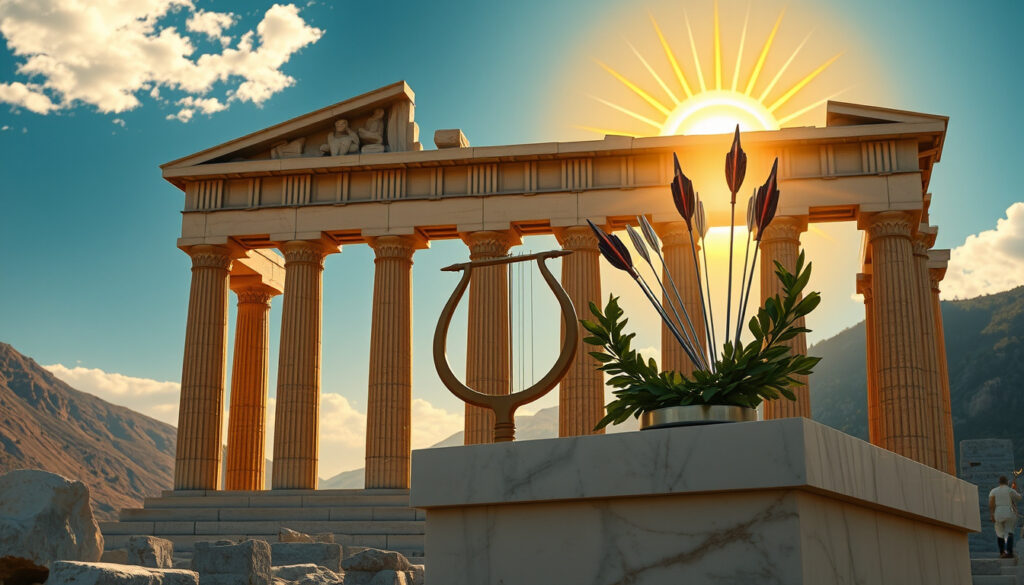
Primary Domains: Music, Prophecy, Healing · Key Symbols: Lyre, Laurel Wreath, Bow · Oracle Site: Delphi · Parentage: Zeus and Leto · Twin: Artemis
Quick snapshot
- God of music, archery, prophecy from Homer Wikipedia – Apollo
- Son of Zeus and Leto, twin of Artemis Wikipedia – Apollo
- Oracle at Delphi Wikipedia – Apollo
- Direct sun god role before Roman-era syncretism Straight Dope Message Board
- Exact dating of when Apollo absorbed solar attributes Straight Dope Message Board
- Apollo in Homeric era: prophecy and music focus (8th century BC) Timeless Myths
- Solar syncretism develops during Classical period onward Timeless Myths
- Apollo’s multifaceted domains continue to influence modern adaptations in literature, film, and neopaganism
| Attribute | Value |
|---|---|
| God of | Music, Prophecy, Healing |
| Symbols | Lyre, Bow |
| Sacred Animal | Raven, Dolphin |
| Famous Oracle | Delphi |
| Parents | Zeus and Leto |
| Twin Sibling | Artemis |
| Homeland | Mount Olympus (Olympian god) |
| Roman Equivalent | Phoebus |
Is Apollo the God of the Sun or Helios?
This is where things get interesting—and where popular knowledge often oversimplifies. The Greeks actually had two distinct sun figures, and their roles diverged in important ways.
Apollo’s Light Associations
Apollo was not originally the sun god in Greek mythology. According to classical accounts, his epithet Phoebus means “bright” or “shining,” which does link him to light—but light in the broader sense of radiance and enlightenment, not the physical orb crossing the sky Mythlok. Apollo’s domains centered on prophecy, music, healing, and archery during the Archaic period, as reflected in Homer’s works.
Helios’ Distinct Role
Helios stands apart as the original personification of the Sun in Greek mythology—a Titan, not an Olympian. He is the son of the Titans Hyperion and Theia, and his siblings include Selene (Moon) and Eos (Dawn) Wikipedia – Helios. Helios drives a golden chariot drawn by fire-breathing horses across the heavens each day, a role that has no connection to Apollo’s functions in the earliest Greek texts.
The syncretism between Apollo and Helios developed over time. By the Classical period and especially under Roman influence, Apollo increasingly absorbed solar attributes, leading to the conflation many people know today Straight Dope Message Board. But in Homer’s Odyssey, Helios’s sacred cattle on Thrinacia feature as a distinct episode involving the sun god’s vengeance—nothing to do with Apollo.
Why Did Zeus Punish Apollo?
Zeus punished Apollo on multiple occasions, reflecting the god’s complex relationship with divine law and mortal affairs.
Context of the Punishment
One of the most famous incidents involves Apollo’s slaying of Python at Delphi. After defeating the serpent, Apollo had to undergo purification and serve penance by laboring for King Admetus. During this service, he helped the king win Alcestis as his bride and tended the king’s cattle Wikipedia – Apollo. The punishment stemmed from Apollo acting outside Zeus’s will by killing the creature at the sacred site.
Aftermath and Lessons
Apollo’s penance demonstrated that even an Olympian god remained subject to Zeus’s authority. His service to Admetus also showed a rare moment of humility for the proud god—assisting mortals rather than commanding them. The myth underscores that divine power operates within boundaries, even when the god in question wields considerable influence.
What Is Apollo the God of? Full List
Apollo’s domain was remarkably broad compared to other Olympian gods, encompassing arts, knowledge, health, and martial pursuits.
Music and Arts
Apollo presided over music, poetry, dance, and the fine arts. He played the lyre—an instrument that became his primary symbol—and was often depicted with the Muses who accompanied his performances Wikipedia – Apollo. His association with poetry made him the patron of poets and musicians throughout the ancient world.
Prophecy and Healing
The Delphic Oracle represented Apollo’s most politically significant domain. Pythia, the priestess at Delphi, delivered prophecies on Apollo’s behalf, influencing decisions from city policy to personal matters Wikipedia – Apollo. Paradoxically, Apollo also governed healing—his son Asclepius became the god of medicine—yet Apollo himself could send plagues with his arrows, as he did in the Iliad.
Archery and Protection
Apollo excelled at archery alongside his sister Artemis. He wielded a silver bow and could strike targets from tremendous distances. He also served as alexicacus, an averter of evil, protecting communities from disease and disaster Wikipedia – Apollo. This protective function balanced his destructive potential, giving him a dual role as both threat and guardian.
| Domain | Key Aspects | Primary Sources |
|---|---|---|
| Music & Poetry | Lyre, Muses, patronage of artists | Homer, Hesiod |
| Prophecy | Delphic Oracle, Pythia priestess | Pausanias, Plutarch |
| Healing | Patron of Asclepius, plague sender | Iliad, Homeric Hymns |
| Archery | Silver bow, protector/avenger | Iliad, Homeric Hymn to Apollo |
| Light/Enlightenment | Epithet Phoebus (“bright”) | Various classical texts |
| Protection | Averter of evil (Alexicacus) | Pausanias |
Who Was Skinned Alive by Apollo?
The most notorious flaying story involving Apollo concerns Marsyas, a satyr whose fate became a cautionary tale about hubris.
The Marsyas Contest
Marsyas was a satyr who discovered an aulos (a double reed pipe) that Athena had discarded and began playing it with considerable skill. Marsyas challenged Apollo to a musical contest, betting his life on the outcome Timeless Myths. The exact terms of the contest and judging process vary across sources, but Apollo’s lyre proved superior.
Symbolism of the Flaying
When Apollo won, he punished Marsyas by having him flayed alive. The punishment exceeded the offense, and ancient Greeks recognized this as an example of divine excessive vengeance. The myth served multiple purposes: it elevated Apollo’s lyre above the aulos in artistic hierarchy, demonstrated the consequences of challenging gods, and provided a gruesome warning about pride.
Many scholars note that Apollo’s punishment of Marsyas was considered disproportionately cruel even by ancient standards—the satyr challenged a god, but flaying was unusually brutal for that crime.
Is Apollo the God of Bisexuality?
This question reflects modern attempts to categorize ancient deities through contemporary lenses, and the answer requires careful historical context.
Mythological Relationships
Apollo had relationships with both male and female figures in mythology. His male loves included Hyacinthus (a Spartan prince), Cyparissus (a youth who became a cypress tree), and Hippolytus. Female loves included Daphne (whom he pursued relentlessly) and Coronis (whom he killed for infidelity). These relationships reflect the homoerotic themes present throughout Greek mythology, where such connections held different social meanings than today Mythlok.
Modern Interpretations
Greek mythology does not organize deities into categories like “god of bisexuality” or “god of homosexuality.” Apollo was associated with masculine beauty, athletic youth (the kouros ideal), and creative arts—but these attributes do not map neatly onto modern identity categories Wikipedia – Apollo. The ancient Greeks distinguished between sexual acts rather than identities, and Apollo’s mythology reflects the cultural norms of his worshippers.
Apollo’s mythology includes both heterosexual and homoerotic elements, but assigning him a modern identity label obscures the different cultural framework in which these stories originated.
Related reading: Proverbs 3:5-6 – Meaning, Context and Application · Harry Potter and the Chamber of Secrets – Plot Summary, Book vs Movie
While Apollo governs music and prophecy, his half-brother Ares, god of war captures the raw violence and chaos of battlefield strife in ancient myths.
Frequently asked questions
What is Apollo known for?
Apollo is known primarily as the god of music, poetry, prophecy, healing, and archery. He also presided over the Delphic Oracle, one of the most important oracular sites in the ancient world.
What is Apollo the god of powers?
Apollo’s powers included prophecy (through the Delphic Oracle), healing and plague, musical inspiration, and archery. He could also purify individuals and avert evil.
What is Apollo the god of animals?
Apollo’s sacred animals included the raven and the dolphin. He was often depicted with wolves, though he was not specifically the god of animals in the way Artemis was goddess of the hunt.
Is Apollo the god of the sun?
In the earliest Greek mythology, no. Helios was the original sun god, a Titan who drove the sun chariot. Apollo absorbed solar attributes through syncretism, particularly during the Roman period, but this was a later development.
What is Apollo the god of life?
Apollo governed domains related to life transitions—youth, maturation, and the passage into adulthood. He presided over coming-of-age ceremonies and the education of young men, particularly in musical and athletic training.
Is Apollo the god of boxing?
Boxing specifically fell under Hephaestus’s domain in some traditions, but Apollo did preside over athletic competition more broadly. The Pythian Games at Delphi, which included boxing, were held in his honor.
Who did Helios fall in love with?
Helios had numerous consorts including Clymene (mother of Phaethon) and Perseis. His most notable offspring was Phaethon, whose catastrophic attempt to drive the sun chariot led to Zeus destroying him.
Upsides
- Apollo represents the ideal of the cultured warrior—combining martial prowess with artistic refinement
- His multifaceted domain made him accessible to mortals seeking various forms of assistance
- The Delphic Oracle under Apollo’s guidance influenced political and personal decisions for centuries
- Apollo’s myths explore complex themes of justice, punishment, and the boundaries of divine power
Downsides
- Apollo’s punishments, as in the Marsyas myth, were often disproportionately cruel even by ancient standards
- His pursuit of Daphne demonstrates troubling aspects of divine coercion in Greek mythology
- The conflation of Apollo with Helios obscures understanding of earlier Greek religious practices
- Apollo’s role in sending plagues made him a source of terror as well as healing
“The main difference between Helios and Apollo is that Helios is the personification of the sun while Apollo is the god of archery, music, and a few other traits.” — Timeless Myths (Mythology resource)
“Helios represents the sun in its physical form while Apollo symbolizes the broader concepts of light and enlightenment.” — Literary Icons (YouTube mythology channel)
Apollo was the most complex figure in Greek mythology—not because he defied categorization, but because the Greeks intentionally gave him an unusually broad domain. Music, prophecy, healing, archery, light, protection—these weren’t separate gods, but rather aspects of a single divine patron. The modern tendency to simplify him as “the sun god” misses this sophistication, flattening a rich theological concept into a single celestial office.
More related posts
 Federal Reserve News Today: Latest Rates, Announcements
 How the Grinch Stole Christmas 1966: Watch, Stream & Facts
 Upholstery Cleaning Near Me: Cost, DIY vs. Professional
 Easy Portuguese Recipes at Home: Quick Dinners & Desserts
 State Farm Pay Bill: How to Pay Online, by Phone, or Mail
 https://aka.ms/remoteconnect: Minecraft Sign-In & Creeper Fixes
 Liga MX Femenil Matches: Schedules, Where to Watch & Title Records
 How to Lower Cholesterol Naturally – Proven Diet and Lifestyle Changes