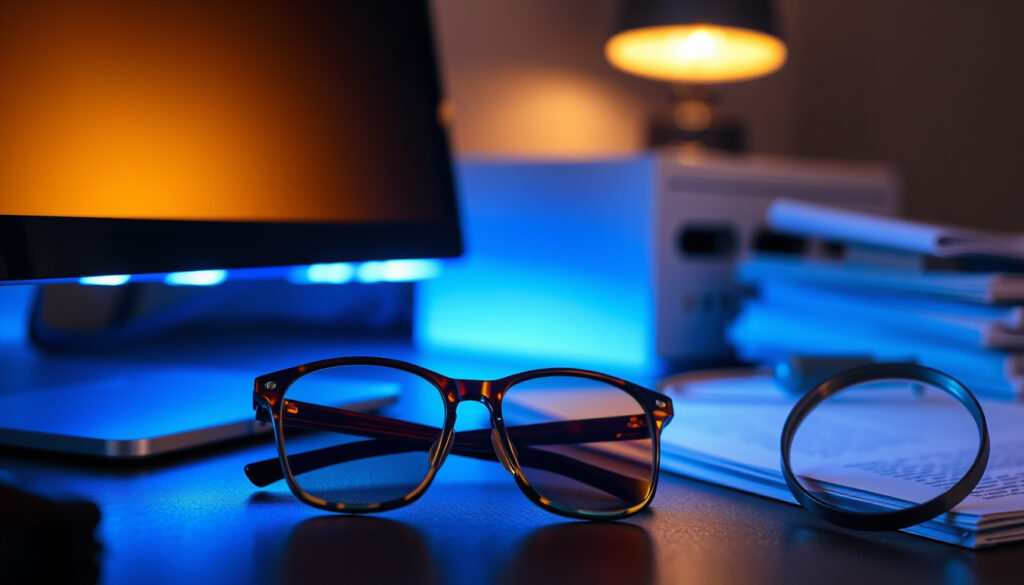
Do Blue Light Blocking Glasses Work? Evidence Review
Millions of people spend hours each day staring at screens, and a growing number are reaching for blue light blocking glasses to protect their eyes. But the science behind these popular lenses is more complicated than the marketing suggests. A major 2023 Cochrane review of 17 randomized controlled trials found that blue-light filtering lenses probably make no difference to eye strain or sleep quality. Here’s what the evidence really says about when these glasses help and when they’re just an expensive accessory.
Adults reporting digital eye strain symptoms: over 60% · Blue light reduction from standard coating: up to 90% · Recommended screen break interval: every 20 minutes · Average reduction in time to fall asleep (study): 7 minutes
Quick snapshot
- Filter high-energy visible blue light using special coatings or tinted lenses (Specsavers IE (optical retailer))
- Reduce glare from screens (Specsavers IE (optical retailer))
- May improve sleep quality when used in the evening (Cleveland Clinic (academic medical center))
- Mixed results for eye strain: Cochrane review found no significant benefit (Cochrane (international health research network))
- Positive for sleep onset in some populations (Harvard Health (university medical publisher))
- Not recommended by AAO for eye strain prevention (Cleveland Clinic (academic medical center))
- People with sleep difficulties who screen late at night (Cleveland Clinic (academic medical center))
- Night shift workers (Cleveland Clinic (academic medical center))
- Those sensitive to bright screens (Cleveland Clinic (academic medical center))
- Color distortion from yellow-tinted lenses (Specsavers IE (optical retailer))
- Cost ranges $15 to $100 with no proven benefit for eye strain (Specsavers IE (optical retailer))
- Not a substitute for screen breaks and proper lighting (Specsavers IE (optical retailer))
Four facts in one view: the product category, the evidence base, the target user, and the known limitations. The gap between what’s marketed and what’s proven is where the real story sits.
The pattern: what the glasses actually do technically and what the science supports are two different things.
| Attribute | Detail |
|---|---|
| Year introduced to consumer market | Early 2010s |
| Typical price range | $15 – $100 |
| Blue light blocked | 20% to 90% depending on lens |
| AAO recommendation | Not recommended for eye strain prevention |
Do blue light glasses really work?
What does the research say?
- The most comprehensive evidence comes from a Cochrane review published in July 2023 (global health research authority) that analyzed 17 randomized controlled trials. Its conclusion: blue-light filtering spectacle lenses probably make no difference to eye strain caused by computer use or to sleep quality.
- A PubMed-indexed systematic review (U.S. National Library of Medicine) from the same year confirmed that blue-light filtering lenses may not attenuate symptoms of eye strain with computer use over the short term compared with non-filtering lenses.
- A 2025 randomized controlled trial cited in PMC (U.S. National Institutes of Health archive) found that blue-light-blocking glasses reduced digital eye strain and visual fatigue, but did not improve contrast sensitivity beyond standard lenses. That trial involved 64 participants over four weeks.
How do studies measure effectiveness?
- Researchers typically measure eye strain using subjective symptom questionnaires and objective measures like blink rate and accommodation.
- Sleep studies use polysomnography or actigraphy, plus subjective sleep quality scales like the Pittsburgh Sleep Quality Index.
- Harvard Health (university medical publisher) notes that a systematic review suggested blue light-blocking glasses may help people with insomnia, but the evidence was not detailed enough to support a firm conclusion.
The same Cochrane review that found no benefit for eye strain also found no harm — meaning the glasses aren’t dangerous, just probably unnecessary for most people. The real cost is the $15 to $100 that could have gone toward a better desk lamp or a blue light filter app.
What do blue light blocking glasses do?
How blue light filters work
- Blue light blocking glasses use special coatings or tinted lenses to absorb or reflect high-energy visible blue light in the 380–500 nm range.
- Most standard blue light coatings filter between 20% and 90% of blue light, depending on the quality and type of lens.
- They do not block all blue light — only a portion, to preserve color perception and avoid excessive tinting.
What types of blue light are filtered?
- There are two bandwidths: blue-violet (415–455 nm) and blue-turquoise (455–495 nm). Most consumer lenses target the blue-violet range.
- Lenses blocking at least 80–90% of blue light in the 400–500 nm range are sometimes recommended for general digital use, though Dream Recovery (sleep wellness publisher) acknowledges the evidence is mixed.
- Specsavers Ireland (optical retailer) states there is not enough research evidence to suggest blue light causes digital eye strain in the first place.
If blue light isn’t the primary cause of digital eye strain — and the evidence suggests it’s not — then filtering it is like putting a water filter on a tap that’s leaking air. The mechanism is real, but the target is wrong.
Do doctors recommend blue light glasses?
Optometrist perspectives
- The American Academy of Ophthalmology (U.S. eye health professional organization) does not recommend blue light glasses for general use. The AAO’s position is that there is no evidence blue light from screens causes eye damage.
- Some opticians recommend them for patients with sleep issues or who are sensitive to bright screens, particularly for evening use.
- Specsavers Ireland (optical retailer) states there is no scientifically proven benefit of wearing blue light blocking glasses for eye health.
Official recommendations from eye health organizations
- Harvard Health (university medical publisher) reports that the AAO advises regular breaks — including the 20-20-20 rule — to help reduce eye strain, not blue light glasses.
- No major health organization — including the American Academy of Ophthalmology, the American Optometric Association, or the Royal College of Ophthalmologists — advises blue light glasses for preventing eye strain.
- Cleveland Clinic (academic medical center) notes that blue light glasses do not prevent eye strain and are not needed for eye health, though they may help some people sleep better.
What are the disadvantages of blue light glasses?
Color distortion and visual comfort
- Yellowish tint can alter color perception, which is a problem for designers, photographers, and anyone who needs accurate color rendering.
- Low-quality lenses may cause headaches or glare due to poor optical quality or uneven coating.
- Specsavers Ireland (optical retailer) notes that the tint can affect how you see colors, which may be annoying for everyday use.
Cost and false sense of protection
- Prices range from $15 for basic online pairs to over $100 for premium prescription lenses with blue light coating.
- There is a risk that wearing blue light glasses gives users a false sense of security, leading to less frequent eye breaks and worse screen habits.
- The Cochrane review (international health research network) found no short-term advantages in using blue-light filtering spectacle lenses to reduce visual fatigue associated with computer use.
The false sense of protection is the most insidious downside. A user who believes their glasses are solving the problem will take fewer breaks, blink less, and likely end up with worse eye strain — the opposite of what they paid for.
Can I wear blue light glasses all the time?
Effects on circadian rhythm
- Wearing blue light blocking glasses constantly can disrupt natural circadian cues if they block blue light during daytime. Blue light during the day signals to your brain that it’s time to be alert.
- Cleveland Clinic (academic medical center) recommends using them primarily in the evening, especially for people who screen late at night, but notes that healthy sleep habits matter just as much or more.
- Generally safe for extended wear, but best used during evening hours to support natural sleep-wake cycles.
The 20-20-20 rule
- The 20-20-20 rule is a separate eye strain prevention technique recommended by the American Academy of Ophthalmology (U.S. eye health professional organization): every 20 minutes, look at something 20 feet away for 20 seconds.
- This technique addresses the actual cause of digital eye strain: prolonged near-focus, reduced blink rate, and poor ergonomics.
- PMC (U.S. National Institutes of Health archive) notes that even the 2025 trial that found reduced eye strain with blue light glasses also required participants to take regular breaks — the breaks may have been the active ingredient.
How to prevent digital eye strain without relying on blue light glasses
The 20-20-20 rule in practice
- Set a timer or use an app that reminds you every 20 minutes to look away from your screen.
- Focus on an object at least 20 feet away for a full 20 seconds. This allows your ciliary muscles to relax.
- Blink deliberately several times during each break to re-wet your eyes.
- Set a timer every 20 minutes.
- Look at something 20 feet away.
- Hold the gaze for 20 seconds.
- Blink deliberately.
- Resume work.
Ergonomics and environment
- Position your screen at arm’s length, with the top of the monitor at or just below eye level.
- Reduce overhead lighting to minimize screen glare. Use a desk lamp for task lighting instead.
- Increase text size and reduce screen brightness to match the ambient light level.
Upsides
- May improve sleep onset when used in the evening (Cleveland Clinic)
- Reduce glare for some users (Specsavers IE)
- No known physical harm from proper use
- Can be a useful sleep hygiene tool for night shift workers
Downsides
- No proven benefit for digital eye strain (Cochrane)
- Color distortion affects visual tasks (Specsavers IE)
- Cost $15–$100 for unproven benefit
- May create false sense of protection, reducing healthy screen habits
What we know and what remains unclear
Confirmed facts
- Blue light glasses reduce the amount of blue light reaching the eye (Specsavers IE (optical retailer)).
- Wearing them in the evening can improve sleep onset in some populations (Cleveland Clinic (academic medical center)).
- They do not reduce digital eye strain more than placebo in controlled trials (Cochrane (international health research network)).
- The AAO does not recommend them for eye strain prevention (Cleveland Clinic (academic medical center)).
What remains unclear
- Whether blue light is the primary cause of digital eye strain (Specsavers IE (optical retailer)).
- Long-term effects of chronic blue light filtration on circadian rhythm.
- Optimal lens specifications for different use cases — the market lacks standardized testing.
- Whether the 2025 trial’s positive results for eye strain will replicate in larger, longer studies (PMC (U.S. National Institutes of Health archive)).
Expert perspectives on blue light glasses
“There is no scientific evidence that blue light from digital screens is damaging to the eyes. Blue light glasses have not been shown to improve eye health or reduce eye strain from computer use.”
— Dr. Raj Maturi, AAO spokesperson, via Cleveland Clinic (academic medical center)
“We find no current research suggesting blue light glasses improve eye health. They may help some people sleep better if used in the evening, but for eye strain, the evidence isn’t there.”
— Specsavers Ireland statement, via Specsavers IE (optical retailer)
“Blue light glasses may help some people sleep better when used by people who screen late at night, but healthy sleep habits matter just as much or more.”
— Cleveland Clinic (academic medical center)
Summary
Blue light blocking glasses are a product that does what it says — filter blue light — but the evidence shows that filtering blue light does not meaningfully reduce digital eye strain, and the sleep benefits are modest at best. The American Academy of Ophthalmology, Cochrane, and major optical retailers all converge on the same message: if you’re buying these glasses for eye strain relief, you’re likely wasting your money. For the Irish consumer browsing Specsavers or Boots, the choice is clear: invest in the 20-20-20 rule, proper screen ergonomics, and evening wind-down routines — or spend €15 to €100 on a lens that may change your color perception without changing your symptoms. The American Academy of Ophthalmology recommends the 20-20-20 rule instead of blue light glasses for eye strain relief.
poudrevalleyeyecare.com, nike.com, healthline.com, midwesteyeassociates.com, dmei.org
For a broader overview of how these lenses are marketed and what users report, see our guide on blue light blocking glasses.
Frequently asked questions
What is the 20-20-20 rule?
Every 20 minutes, look at something 20 feet away for 20 seconds. This is recommended by the American Academy of Ophthalmology to reduce digital eye strain.
Do blue light glasses help with headaches?
There is no strong evidence that blue light glasses reduce headaches caused by screen use. The Cochrane review found no significant effect on eye strain, and headaches are often a symptom of eye strain.
Are blue light glasses the same as computer glasses?
Not exactly. Computer glasses may include blue light filtering plus anti-glare coating and magnification for intermediate distances. Blue light glasses only filter blue light.
How long does it take to notice benefits from blue light glasses?
If they help with sleep, users may notice differences within a few days of evening use. For eye strain, most studies show no benefit even after weeks of use.
Can children use blue light blocking glasses?
There is no evidence that children need them. The AAO does not recommend blue light glasses for children, and the same screen hygiene rules apply: breaks, distance, and outdoor time.
Do blue light glasses affect night vision?
In very dim conditions, the amber tint may reduce overall light transmission slightly, but they do not significantly impair night vision for most users.
Should I buy blue light glasses from a store or online?
If you choose to buy them, opt for reputable retailers like Specsavers or Vision Express that offer quality guarantees. Online budget pairs may have inconsistent coating and poor optical quality.
More related posts
 Weightlifting Fairy Kim Bok-joo: Worth Watching? Full Guide
 Carl’s Jr. Near Me: Current Locations and Menu (2024)
 Dish Network Phone Number – Official Contacts and Hours
 Best All Inclusive Resorts in Florida: Top 10 List
 Taylor Jenkins Reid Books: Reading Order & Guide (2025)
 Brittney Griner as a Kid: Height, Bullying & Early Life
 What Level of Eosinophils Indicate Cancer? A Medical Guide
 Round 2 NFL Draft 2026: Order, Picks, Times & Grades