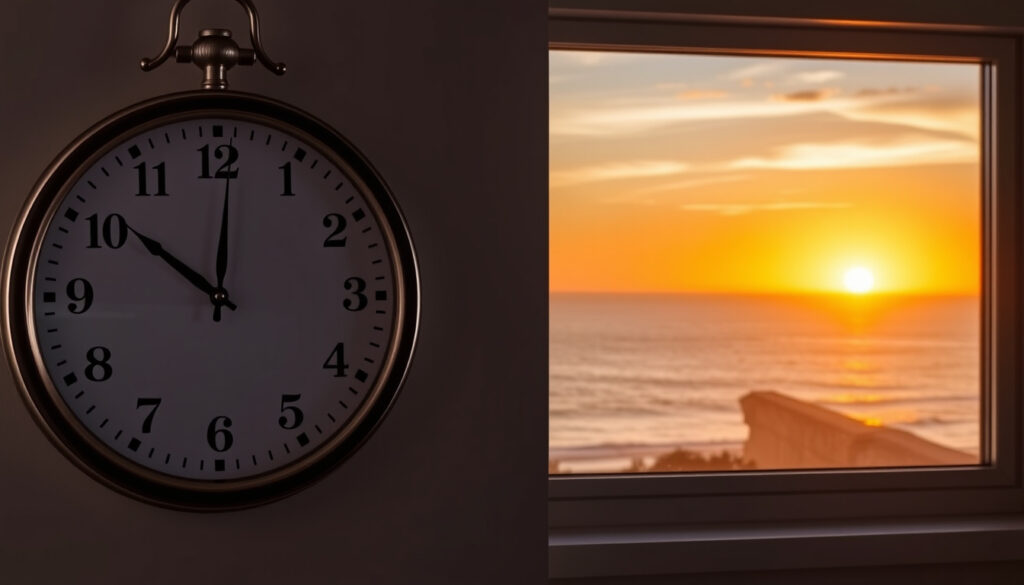
Current Time in California Now: PST, PDT & Time Zone Guide
You probably know someone who’s asked, “Wait, is it AM or PM in California right now?” It’s a simple question, but between Pacific Daylight Time, the switch to standard time, and the eternal 12-hour clock confusion, the answer isn’t always obvious. This guide cuts through the time zone fog — giving you the live time, the rules behind it, and the differences that matter when you’re coordinating across the country or the globe.
Current time in California Live – see Timeanddate.com ·
Time zone name Pacific Time (PT) ·
UTC offset (standard) UTC –8 ·
UTC offset (daylight time) UTC –7 ·
Daylight Saving Time Observed (March to November) ·
State capital Sacramento
Quick snapshot
- California currently observes Pacific Daylight Time (PDT) with UTC offset –7 (Worldometer)
- DST transition: second Sunday March (spring forward) and first Sunday November (fall back) (Time and Date)
- IANA time zone identifier: America/Los_Angeles (Worldometer)
- The exact second of the current time changes constantly; always use a live clock
- Whether your device auto-adjusts for DST depends on your settings and network
- PDT active until first Sunday of November 2026 (time.is)
- Next PST start: November 1, 2026 — clocks fall back 1 hour at 2:00 a.m. (Time and Date)
Four key facts distill the essentials:
| Label | Value |
|---|---|
| Current time in California (example) | 5:14 PM PDT (as of July 5, 2026) |
| Time zone abbreviation | PDT (Pacific Daylight Time) during DST |
| UTC offset now | UTC–7 |
| State capital | Sacramento |
Is it AM or PM in California now?
This is the most common question — and the answer depends on where the sun is. As of mid-2026, California is on Pacific Daylight Time, so daytime falls between roughly 6:00 a.m. and 8:00 p.m. PDT. Right now, if you’re reading this during daylight hours in California, it’s PM; if it’s dark, it’s AM. But let’s be precise.
Is AM night or day in California?
- AM stands for ante meridiem (before noon) — midnight to 11:59 a.m. (National Physical Laboratory, UK’s national measurement institute)
- PM stands for post meridiem (after noon) — noon to 11:59 p.m.
- When it’s night in California (after sunset), the time is PM; the early morning hours (before sunrise) are AM.
If you’re checking the time at 3:00 a.m. local — that’s AM, without question. The sun hasn’t risen, and California’s 12-hour clock still follows the same global rule.
What time is it in California right now in PST?
Technically, when California is on daylight saving time, it’s not PST — it’s PDT. But many people still say “PST” out of habit. The accurate current time is provided by authoritative sources like WorldTimeServer and time.is, which update every second.
What time is it in California just now?
- Live clocks for major cities: Los Angeles, San Diego, San Francisco, and Sacramento all share the same Pacific Time offset (Worldometer)
- During PST (standard time), the offset is UTC–8; during PDT (daylight time), it’s UTC–7 (U.S. Naval Observatory)
- As of July 2026, California is in PDT, so the offset is UTC–7 (WorldTimeServer)
The implication: when you see “PST” in a search result, double-check the date. From March to November, the correct term is PDT.
Is California 8 hours behind?
Only during Pacific Standard Time. During daylight saving time, California is 7 hours behind Coordinated Universal Time (UTC–7). The 8-hour number sticks because it’s the standard-time offset, and many people remember it that way.
How far behind GMT is California?
- During PST: UTC–8 (8 hours behind London’s GMT) (U.S. Naval Observatory)
- During PDT: UTC–7 (7 hours behind London’s BST) (U.S. Naval Observatory)
Is California time 3 hours ahead or behind?
- California is 3 hours behind Eastern Time (e.g., New York, Florida) (Wikipedia)
- California is 2 hours behind Central Time (e.g., Chicago, Dallas)
- California is 1 hour behind Mountain Time (e.g., Denver, Phoenix)
What states are 3 hours ahead of California?
Any state in the Eastern Time Zone: New York, Florida, Georgia, North Carolina, Ohio, Michigan, and most of the East Coast. For example, when it’s 12:00 p.m. in Los Angeles, it’s 3:00 p.m. in New York.
Three time differences, one pattern: the farther east you go, the more hours you add. The Pacific Time Zone is the westernmost of the contiguous U.S. time zones, so every other time zone is ahead.
A traveler flying from New York to San Francisco loses 3 hours on the clock — but the flight is only 6 hours long. That’s why many West Coast callers schedule meetings before 10 a.m. PT to catch East Coast offices before 1 p.m. ET.
Is PST the same as PDT?
No — they are two different offsets within the same Pacific Time Zone. PST is used in winter (early November to mid-March), and PDT is used in summer (mid-March to early November). Both are part of the Pacific Time Zone, and the abbreviation changes with the season (Time-Time.net).
When does Daylight Saving Time start and end in California?
- Start: second Sunday of March — clocks spring forward at 2:00 a.m. local time (Time and Date)
- End: first Sunday of November — clocks fall back at 2:00 a.m. local time (Time and Date)
- California switched to PDT on March 8, 2026, and will return to PST on November 1, 2026 (time.is)
The catch: many digital devices update automatically, but wall clocks and older appliances need manual adjustment. Always confirm the date before assuming PST or PDT.
Midnight – is it 12am or 12pm?
This is the most persistent source of schedule errors. According to the National Physical Laboratory, midnight is 12:00 AM — the start of the day. Noon is 12:00 PM. In everyday California usage, 12 AM refers to the middle of the night.
Is 12 am night or day?
- 12:00 AM = midnight (night) — the instant the day begins
- 12:00 PM = noon (day) — the instant the sun is highest
- To avoid confusion, many digital clocks and timetables use 00:00 for midnight (ISO 8601 standard)
How does the 12‑hour clock work in California?
California, like the rest of the U.S., uses the 12-hour clock for everyday life. Times are written as “12:00 AM” or “12:00 PM”, and the cycle repeats twice a day. The military and some transit systems use 24-hour time (e.g., 00:00 for midnight).
California time vs. other major cities: comparison table
Five cities, one pattern: the difference from California is largest in the opposite direction. Here’s how they stack up during PDT (summer) and PST (winter).
| City | Time zone | Difference from California (PDT) | Difference from California (PST) |
|---|---|---|---|
| New York | Eastern Time (ET) | +3 hours | +3 hours |
| London | British Summer Time (BST) / GMT | +8 hours (BST) / +7 hours (GMT) | +8 hours (GMT) |
| Tokyo | Japan Standard Time (JST) | +16 hours | +17 hours |
| Denver | Mountain Time (MT) | +1 hour | +1 hour |
| Chicago | Central Time (CT) | +2 hours | +2 hours |
The trade-off: when it’s 9:00 a.m. in California during PDT, it’s already 5:00 p.m. in London and 1:00 a.m. the next day in Tokyo. That’s why international calls often require a spreadsheet.
What’s confirmed — and what’s still unclear
Let’s separate the facts from the gray areas.
Confirmed facts
- California currently observes PDT (as of July 2026) (Worldometer)
- Pacific Time Zone offset is UTC–8 (standard) and UTC–7 (daylight) (U.S. Naval Observatory)
- DST starts second Sunday March, ends first Sunday November (Time and Date)
- California is 3 hours behind Eastern Time (Wikipedia)
What’s unclear
- Whether permanent DST will be adopted in the U.S. — legislation is still pending (Wikipedia)
- Your device’s exact DST auto-adjustment depends on firmware and region settings
Expert perspectives on time zone clarity
“Midnight is 12:00 AM and noon is 12:00 PM. This is the standard definition used by the international standard ISO 8601 and by the UK’s National Physical Laboratory.”
— National Physical Laboratory, UK’s national measurement institute
“Real-time clocks and authoritative time zone information are essential for scheduling across different time zones, especially during daylight saving transitions.”
— Timeanddate.com, global time resource
For anyone coordinating across time zones, the key takeaway is simple: check the current UTC offset. If California is on UTC–7, you’re in PDT; if UTC–8, you’re in PST. The rest is arithmetic.
savvytime.com, globeair.com, worldtimeserver.com, 24timezones.com, pst.net
For a live clock and detailed time zone guide, check the current time in California page.
Frequently asked questions
What time zone is California in?
California is in the Pacific Time Zone (PT). During standard time it uses Pacific Standard Time (PST, UTC–8), and during daylight saving time it uses Pacific Daylight Time (PDT, UTC–7). (Worldometer)
Is California on PST or PDT right now?
As of July 2026, California is on Pacific Daylight Time (PDT). To check the current status, visit a live clock site like time.is.
When does daylight saving time start and end in California?
DST starts on the second Sunday of March (clocks spring forward) and ends on the first Sunday of November (clocks fall back), at 2:00 a.m. local time. (Time and Date)
How many hours ahead is New York from California?
New York (Eastern Time) is 3 hours ahead of California. When it is 12:00 p.m. in Los Angeles, it is 3:00 p.m. in New York. (Wikipedia)
What is the current time in Los Angeles?
Los Angeles shares the same time as all of California — Pacific Time. For the exact current time, use Timeanddate.com.
Is California 8 hours behind London?
Only during Pacific Standard Time (PST). During PDT (summer), California is 7 hours behind London. The difference varies because the UK also observes daylight saving time. (U.S. Naval Observatory)
How do I convert California time to my local time?
Find California’s current UTC offset (either UTC–7 or UTC–8) and add or subtract the difference to your own time zone. Online tools like WorldTimeServer do the math for you.
Related reading
More related posts
 Disney+ Begin: Activate Your TV at disneyplus.com/begin
 FC 26 Release Date, Early Access, and 80% Steam Discount
 How Tall Is Stephen Miller? Height Controversy (2025)
 Did Charlie Kirk Get Shot? Latest Verified Information (2025)
 Galaxy S7 to Buy in 2025: Price, Worth & Buying Guide
 Stefon Diggs Cardi B: Breakup, Baby, Viral Video Timeline
 Salmon in Air Fryer: Cook Time, Temperature & Common Mistakes
 2025 Military Pay Chart: 4.5% Raise, BAH & Calculator